I am a cyclist and a driver. Unfortunately, I think the only way forward for cyclists is intense litigation against both cities and drivers around car collisions. The city will not prosecute cars for dangerous driving or violations, even if they hit drivers. Its crazy to me how getting caught going 15 miles over the speed limit will double your car insurance rates, but hitting a cyclists won't do anything because as a driver you can say "they darted into the lane" to any cop and won't be cited for anything. I was hit by a car once, had my bike totaled, and got a small settlement from the driver's insurance company. If I was hit again, I would immediately go to a lawyer and take the insurance company to the cleaners an donate all of the money to a bicycle advocacy org, and I advise everyone I know who gets hit to do the same thing. It sucks but it seems like personal injury law is the only avenue to make change here and introduce some form of penalty and feedback to hitting a cyclist with a car. There is no infrastructure to stop this because drivers don't care, they can hit cyclists without consequence.
I've been hit twice. Both times I was at a stop sign. The second time the guy just said "oh sorry, the sun was in my eyes." Meanwhile I thought I was going to be pushed into moving traffic and die by someone who in no way could have avoided me. Took me a full minute to catch my breath and gain enough composure to lay into the guy who hit me. He never got out of his car, never said sorry (real sorry), nothing. I've had cars chase me because they don't think I should be riding in the right most lane (no bike lane or construction).
One time a Pizza Hut driver almost killed me. I called his boss, they didn't care.
One time an UBER DRIVER almost hit me and then proceeded to chase me because I yelled and flipped him off. I sent a photo of the license place to Uber and the local PD, nothing. Not even an acknowledgement.
The fact is that people don't care. You go on HN or Reddit and people will complain and actively encourage hitting riders. It is always the rider's fault, even if the driver broke the law. And I'm tired of it. I don't care if the rider was in the wrong, you're a lot more squishy on a bike than in a plastic housing with a motor. There's this weird dichotomy of not caring about the life or safety of someone.
In the Netherlands (as I understand it) the assumed-at-fault party in any crash is the one with the heavier weight-class vehicle. So a semi is assumed at faul over a truck, that’s assumed at fault over a sedan, over a motorcycle over an e-bike, over a bicycle, over a pedestrian. Or something along those lines.
Always seemed like a reasonable policy to me. The people operating heavier vehicles have a higher inherent responsibility to operate them safely.
Yes, that is indeed a sensible approach, but it will be difficult to implement here because the law in North America tends to side with drivers first and foremost.
I found it very enlightening to learn that even in the Netherlands, there used to be car culture similar to here, and it took the death of some children, and a grassroots campaign, before meaningful change began to occur.
There are many lessons to learn from the Netherlands with regard to bicycle infrastructure, and for our sake I certainly hope it doesn't involve the death of children.
> There are many lessons to learn from the Netherlands with regard to bicycle infrastructure, and for our sake I certainly hope it doesn't involve the death of children.
Like the Netherlands, the city of Copenhagen has a highly evolved bicycle infrastructure, but the catalyst for change was the dual oil crises in the 1970s which led to car-free Sundays and other oil preservation measures. People disovered that they actually appreciated the lack of cars and many started using bicycles as an alternative. This resulted in a grassroots movement campaigning for bicycle infrastructure in the city. The municipality caught on and today almost two thirds commute by bicycle.
Well, that is better, but then there are those scooters and other small motorcycles that are allowed to go on bike lanes for some reason, which - while living in Amsterdam - I felt were a menace, regardless of whether they'd be assumed-at-fault or not.
Yes this is true, but because of the separated infrastructure there are much fewer collision point between motorized and non motorized traffic. Basically all streets where cars can drive 50kmph (30mph) and up cyclist have a separate cycle path.
I stopped in a bike lane to take a picture of an illegally parked Uber driver. He used his vehicle to try and plow me out of the lane and cut short my window of opportunity for a photo.
Reaction from police and Uber to a photo with the plate and the car making contact with my bike? "meh"
I think in Belgium and Netherlands most people are brought up to ride bicycles at a young age. You're only allowed to drive at the age of 18, so a bicycle is how you get around as a teenager. It helps that those are dense countries so you usually don't have to cycle far to get to school/friends/city.
Because most of us grow up that way, later in life, when we drive a car, we have the proper respect for bicycle riders. We drive slower when we overtake them, we looks in our mirrors before taking a turn.
good infrastructure helps too, but from having lived in the US and Europe, I think it's largely a cultural thing.
I was cycling on an empty, straight country road in daylight once. A guy in a car turned onto the road a nearly hit me. So unnecessary. He could have just waited 2 seconds for me to pass. I was incandescent with rage and gave chase, while screaming obscenities. Just as well he didn't stop as it was a long uphill and I would have been barely able to stand, let alone fight. ;0)
That sucks but what do you expect to happen given your photos are proof of nothing. It's just your word and a command to the police to "go punish this guy because I said so!"
I wish there were more places with bike lanes like Amsterdam and Copenhagen
> If a car hits a walking or cycling person, whatever the situation they are at fault.
This is insane. Cyclists run stop signs, red lights, etc. all the time. Pedestrians run out in to traffic from behind parked cars. If they get hit when they do that it's their own fault.
What everyone needs to understand in every mixed traffic environment is that sharing the road goes both ways. Drivers have a responsibility to look out for cyclists, but cyclists have a responsibility to make themselves able to be seen. Everyone has a responsibility act in a way that allows their actions to be predicted by other users of the road, you never want to be surprising people.
If your actions cause someone to have to hit their brakes or make evasive maneuvers and you had a reasonable choice to not do those things, you're the one in the wrong even if you're legally right.
Drivers are in control of potentially deadly machines. When I got my driver's license I was taught to always be prepared to stop in case somebody does something stupid. I think defaulting to having the driver at fault is reasonable. If they have proof they couldn't possibly stop, they are free to take the case to court.
Its not insane; on the contrary, it is clever. The risk of physical damage is higher with a cyclist, than a car. The law tries to balancethat risk/reward out, and it leads to car drivers driving more safe because now the risks are higher.
Furthermore, a lot more cyclists fit in a city than cars, and they are more likely local population who also take care of local Co2 reduction. Although tourists are welcome to cycle as well.
cycling is a chicken and egg problem. while you're all saying "cyclists are responsible for being seen" then cycling stays as macho hobby. As a UK cycle commuter who travels a lot to Netherlands, the big thing they did there is to make it normal and easy for everyone to cycle. Not just fit macho well equipped enthusiasts but children, elderly, timid, and badly equipped. Once the bike lane is fully separated and well lit and full of other cyclists you don't need high vis gear and excellent situational awareness to avoid being killed and that makes cycling universally accessible and slashes the number of cars required
Well, in France, some accidents are not a matter of law, but insurance arbitration. There is not "whatever the situation", just a default assumption that pedestrians and cyclists have priority. Then there is a case study.
The insurance arbitration can be weird though: if you are getting out of a parking spot, with all the indicators and cautious maneuvers, and get hit, you are at fault. Bike, car, bus ...
I'm from the south and don't really see a problem to call it Holland which is why I used that word, even while I reconsidered using the more correct "The Netherlands".
The distinction between Holland / Netherlands is not interesting unless you are from down here. It is similar to the distinction between hackers & crackers. Yes it is different, no.. most people don't care (and shouldn't care IMO).
The letter was more "hey, people keep running this particular stop sign and this is the main bicycle path that students use to get to school. Please do something about it. Maybe like cutting back the tree in front of the stop sign or posting someone"
Instead they added a stop sign to the main road and now more people run that particular stop sign.
> I don't care if the rider was in the wrong, you're a lot more squishy on a bike than in a plastic housing with a motor.
This is so weird to me. It’s the complete opposite in the Netherlands. Because you are in a car, and you are best protected, you’re basically always in the wrong if you hit a cyclist or pedestrian, regardless of what they were doing (at least that’s what I was taught).
I’m sorry you had these experiences. I too got hit twice, but no major damage other than totaling my bike.
The reason why I have little sympathy for these types of stories is that I witness cyclists being assholes every day I drive. Stuff like running lights and stop signs, changing lanes with no signals, riding on sidewalks and crosswalks, riding in lanes with moving cars, etc etc.
I understand that in the US bike environments are really unsafe, but I don’t think that routine not obeying traffic laws or conventions is the way to go.
> riding on sidewalks and crosswalks, riding in lanes with moving cars
In one sentence you managed to point directly to the dichotomy cyclists face. Car drivers: “get out of the road it’s for cars!”, pedestrians: “get off the sidewalk it’s for pedestrians!”
In many places there just isn’t safe areas for cyclists that doesn’t end up putting them in conflict with other users of streets.
One thing that’s hard on a bicycle is to keep your cool after a collision or near miss. You end up with so much adrenaline pumping that anger often comes.
Like others on this thread have mentioned though, getting angry at people in cars is not helpful, best case they feel bad, worst case they become angry and now have a multi-ton weapon on their side.
> In many places there just isn’t safe areas for cyclists that doesn’t end up putting them in conflict with other users of streets.
Cyclists are unambiguously wrong if they cycle on the pavement. Just as cars drivers are unquestionably wrong when they are in a cycle lane. This is cycle riders doing to pedestrians exactly that they don’t want drivers to do, and this is dangerous for people who are in a more vulnerable position than they are. I have zero sympathy for riders on the pavement, I’ve had too many collisions or near misses, including with small children.
It’s also often more dangerous for the cyclist anyway because drivers pulling out of parking lots, alleys, side roads, etc. nose their way into the crosswalk as long as no pedestrians are in their immediate way. They aren’t expecting a bike going 15-20 mph on the sidewalk.
I don’t think I’m explaining myself properly. I mean that if a car is already in a section of a lane, a bike would ride alongside a car on the left or right side, in the same lane.
Just like you couldn’t have two cars side by side in a lane, you can’t have a bike and a car in the same lane.
We have mixed traffic with bikes and cars on the same road, but they’re supposed to be sequential, not side by side.
Here’s an example of what I mean.
I’m on a single lane suburban road with a line of 20 cars all going 10mph. A bike rides alongside me going 20 mph in the same lane, passing me and other cars. The bike is 1-2 feet away from the side of my car.
In my jurisdiction it's also "required" for cars to give a cyclist the lane, but in practice this doesn't happen and violations are rarely enforced. A cyclist claiming the whole lane is also more likely to be on the receiving end of road rage
Again, I’m not saying that cars are perfect. I was just pointing out how I frequently see cyclists breaking traffic laws and norms. I don’t think that because cars are assholes that bikes can be too.
Do you think it’s appropriate that a bike passes a car in its own lane? Do you think the law should be changed to allow this?
And do those cyclists “being assholes” kill 50000 Americans a year? Or even close to the proportional equivalent?
The fact that people driving 2 ton steel killing machines complain about cyclists being “assholes” when it’s overwhelmingly their killing machines that, you know, kill cyclists, pedestrians, and other people in killing machines, is a remarkable display of entitlement.
>Do you think it’s appropriate that a bike passes a car in its own lane?
This is entirely situational. There are cases where it is OK and there are cases when it isn't.
There was an Uber blocking traffic on my street today and I went past them. It would be ridiculous to have to just sit behind the car until their passenger showed up, and I'm sure as hell nit gonna ride my bike into oncoming traffic
>Do you think the law should be changed to allow this?
It doesn't need to be changed. The law in my state already allows this under many circumstances
Pedestrians can shove it. Cyclists on the sidewalk are nowhere near as annoying or dangerous as cyclists on the road, and pedestrians who work to keep cyclists on the road and off of sidewalks have the blood of the unlucky cyclists on their hands...
This is a truly terrible perspective. Many pedestrians are slow and extremely vulerable to the effects of being toppled by a wheeled vehicle. This is particularly a problem when people are leaving buildings onto sidewalks unaware of cross traffic moving at 10+ kph. Bicycles belong on the road with other vehicles.
Honestly bicycles belong in their own dedicated spaces. As a driver I don't want them on the road and as a pedestrian I don't want them on the sidewalks. Bike lanes are a start but we need dedicated bike infrastructure.
As if the drivers are cool and level headed while mowing cyclists down? People fearing for their lives are allowed to be agitated.
And if you don't want to take a diverse group of people seriously because of some slight you have with a minority of them, you're not really interested in taking them seriously in the first place, and are just looking for excuses. Classic tactic used to neglect lots of groups one's not in. "If the millions of BLM supporters want to be taken seriously, they shouldn't have a few people among them rioting!" is another example.
Before roads were for cars they were for horse+buggies, or chariots, or other transport. Cyclists are not first-class citizens on roads and they never will be. And frankly I don't want to get stuck behind one on a road with a dramatically higher speed limit than what you can pedal at. That shit is just rude.
The amount of entitlement that seems to come from the cycling community makes it really hard for others to empathize with your situation. You can make a bad faith argument comparing yourselves to BLMers if you want, but I can see right through it.
Appreciate your sitaution as a minority among minorities and plan your moves appropriately. But thinking that cyclists should get higher priority over multi-ton cars and such you are mistaken.
> People fearing for their lives are allowed to be agitated.
Don't forget that by cycling you are choosing to bring a knife to a gunfight.
> This is particularly a problem when people are leaving buildings onto sidewalks unaware of cross traffic moving at 10+ kph. Bicycles belong on the road with other vehicles.
I can never understand how anyone can make this argument without seeing how it applies even harder to why bicycles shouldn't be on the road with cars going 45+ MPH (~70+ km/h).
Bicycles are closer to pedestrians than cars outside of the slowest city roads.
Agreed. When I got my bike for the first few weeks I would ride on the sidewalk. Until my wife pointed out that in our residential neighborhood, anybody could back out of their driveway and hit me and it would be my fault as I would be in their blind spot.
Since then I bike on the road.
Show me evidence that cyclists on sidewalks are responsible for even 5% of the fatalities that happen from cyclists being on the roads. I think you're the one with the terrible perspective.
Most sidewalks are way too damn narrow for passing a pedestrian IMHO. I stick to bike trails and side streets, sidewalks only exist in my route planning for emergency maneuvers.
Also I live in New Orleans where having a few feet of very broken, ragged sidewalk due to a tree's roots bursting up through them as the pavement slowly sinks is a very common sight. Trust me you do not wanna bicycle on that shit.
Certainly, I don’t think car drivers are perfect by any means. I’m not sure the exact ratio, but I see cars speeding every day as well. But it’s pretty rare to see a car run a red light or weave around other cars.
I would love to live where you live. Around me in a US city, cars stop in crosswalks, run reds, ignore left and right turn rules and swing into turns like no one could ever possibly be crossing or cycling. And I live in what's supposedly the bike and ped friendly core.
Just this weekend in my neighborhood, and elderly woman was murdered by a driver hooking a left turn while she was in a crosswalk. Same neighborhood, a homeowner had a driver crash into her home for the second time in three months!
Driving culture in the US is undisciplined and low-skilled. The requirements for earning a license are far too low in every state.
Where I live, drivers, bicyclists, and pedestrians are all insane. When I’m driving I don’t trust any of them. When I’m walking, I don’t trust any of them. I don’t bike here because I don’t want to die. My fifteen minute, five mile commute is never completed without witnessing egregious violations.
My city seems dedicated to making the roads as deadly as possible. Rather than having bicycles go down a parallel road, they gave them a bike lane on the main road. Thing is, there is no real benefit to bicyclists to be on that road versus a parallel road. I wouldn't bike on that road for pay. The city also added speed bumps. So idiot drivers drive into the bike lane to go around the bumps. The same city has changed left + straight lanes to be left only and right only lanes to be right + straight. This has the effect of "no turn on red" which should reduce danger to pedestrians... but the lanes don't always line up, sometimes there are near collisions because people think they are in the straight lane or because people turning an unprotected left in the opposing traffic think they are in a turn lane (and indicators are optional).
I could rant on for pages.
I don't know the solution. I now drive first for my own safety, second to limit my own liability, and third for the safety of others. I equate that with giving up. But on one side are idiots that think the road should be built just for them and on the other side are well-meaning idiots that remove the double yellow lines because drivers slow down. One thing I do know is that pedestrians, bicyclists, and drivers should be kept physically separate wherever possible.
My personal belief is that there must be a very low bar for driving because In many places in the US, if you don't have ready access to a car for transportation, your life will be very difficult. Poor public transportation combined with massive sprawl ensure this.
Also, generally speaking, Americans do not like things that add perceived barriers to their personal freedom and independence, so any proposal to make it more difficult to get a license would probably be unpopular.
I think if you picked a random population of cars, and a random population of bikes, the cars would more regularly break the law - generally speeding (full disclosure, I generally go 10-15 over the speed limit when driving).
Then consider injuries caused by breaking the law on the road. Bikes breaking the law cause few, speeding cars cause many.
Dismissing the regular lawbreaking of cars doesn’t seem rational. Just because you don’t like the way bikes break the law doesn’t mean bikes breaking the law has a negative impact.
Cursory search turns this up:
> Speeding was a factor in 26% of all traffic fatalities in 2018, killing 9,378, or an average of over 25 people per day.
Let’s say the ratio of violations per mode is the same. In the city I live in, bicyclists make up <1% of road users. So the drivers operating their vehicles dangerously out number bicyclists doing so 100:1. And vehicles are what are killing and severely injuring people, not bicyclists.
Sure. But both those things are equally illegal, and a car exceeding the speed limit is more likely to cause serious injury or death than a bicycle running a red light. So why treat the latter as somehow worse than the former?
At peak time, I can stand at the crossing outside Old Kent Road ASDA for 5 minutes and see 3-5 cars actively jumping a red light with 5-10 others entering the junction without a clear exit (means other cars and pedestrians have to weave around them when the lights change.)
They’re supposed to ride in the road and occupy a lane just like another vehicle. If a bike is in the lane then a car shouldn’t enter the lane and should pass when safe. Likewise bikes shouldn’t enter a lane with a car.
What I meant is a bike shouldn’t ride alongside a moving car in a lane but should be ahead or behind, like any vehicle.
When I'm on a bike, I honestly don't feel safe taking up the entire lane. I guess in theory the expectation is that cars will calmly drive behind my slow bike until there is room to pass, however long that may be, but I know that people are going to get impatient, and that just makes it feel less safe, or inappropriate. I feel like at any second I'm going to get startled by a loud car horn right behind me, which is very distracting.
So for me the sharrows do make a difference, since they make it feel safe to use more of the road, which makes me do it.
I’ve listened in on a few community board meetings on road safety in New York City in order to better understand the situation, and was really put off by how the bicycle advocates were simultaneously demanding more protection from the police while openly mocking the suggestion that they need to stop running red lights. The hypocrisy of disrespecting the law while requesting more severe enforcement of the law against their opponents felt really gross and caused me to check out on the issue of bike safety completely.
I'm not condoning it, but you might want to understand why cyclists typically run red lights and stop signs. The reason is the top most dangerous spots for a cyclist are 1) sitting at an intersection and 2) passing though an intersection. If I cross an intersection starting from non-zero momentum I can cross it in 2 seconds. If I start from zero it take more than 5. Now I'm not just going to go through an intersection without checking, but I'm going to slow down, check, and go, because that's what's safest for me. This is what I see the vast majority of people do. Now I've seen people not do that and just blast through, but I can't count more than 5 in my entire life that have done that. You know what happens when you do fully come to a stop and the intersection is clear? Cars honk at you. Cars get real close. People yell about how you aren't supposed to be on the road and threaten you. I'll take my chances with the intersection, considering I've been chased by some of these people on more than one occasion.
This again comes back to the fact that cyclists are neither pedestrians nor motorized vehicles. It isn't a surprise that they want to be treated like cyclists and not be in that binary classification. It is only hypocrisy if you use the wrong classifications. If you're really trying to understand bike safety try riding in their shoes for a month or two. You'll start to get it real fast.
While the cyclists might have very valid reasons for breaking the law, the fact is that at present, the law classifies them as "vehicles" and classifies them as subject to the same rules as the other vehicles (the cars).
Regularly watching cyclists flaunt the rules that the car driver would be cited for breaking, and never seeing a single cyclist cited for the law breaking, leaves a foul taste for cyclists in the mouths of many motorists. They don't get to run stops or red lights with impunity and without punishment.
So as long as the law says cyclists must obey the same rules car drivers are also supposed to obey, the subset of cyclists that break those rules on a regular basis do not help, in the least, the arguments to try to convince car drivers to be more respectful of cyclists.
The start should be the cyclists obeying the same rules as the cars (which would help with not pissing off numerous car drivers daily) while working the politician angle to change the rules for cyclists to something safer for cyclists (and at which point the car drivers will no longer have a way to rationalize their hatred of the cyclists as just "law breakers").
> The start should be the cyclists obeying the same rules as the cars (which would help with not pissing off numerous car drivers daily)
The problem is that as your parent commenter pointed out obeying these laws also pisses off drivers. Drivers get pissed off when cyclists take the full lane, and they get pissed off when cyclists come to a full stop in front of them at a stop sign. I don't run red lights and stop signs on my bike and it annoys me when people do, but I feel like the many violations drivers commit every day are just normalized because there are so many more drivers than cyclists.
Not to mention that safety is more important than getting a ticket. It is unsurprising that people choose the safer option over the legal option. Plenty of laws are broken and "it's the law" has never been a great excuse.
We should also consider that many people have different definitions for "running a stop sign" and it isn't equally applied to cars and bikes. A roll at a stop sign is ignored for a car but "running" for a bike. I don't blow through (that's irresponsible), but I do roll, per the given reasons above (funny enough I never roll when driving).
> Regularly watching cyclists flaunt the rules that the car driver would be cited for breaking
Yes and no. I am sorry when cyclists flaunt the rules — it does happen — but there are also those of us that strictly obey the law. (It helps keep me alive.) But I see cars break many of the same rules, quite often. For example, seeing a car run a red isn't even a rare thing. (A rare one is seeing a car driving the wrong way.) Between the two groups, I don't think I see one break the rules more often than the other. (I certainly see more violations from motorists… but I also see more motorists.)
> never seeing a single cyclist cited for the law breaking,
I've seen this, multiple times. Oddly, only while biking. Probably about as (in)frequently as I see motorists get cited.
> So as long as the law says cyclists must obey the same rules car drivers are also supposed to obey, the subset of cyclists that break those rules on a regular basis do not help, in the least, the arguments to try to convince car drivers to be more respectful of cyclists.
That there are those out there that don't obey the law should not matter to validly argue that the world would be better — that is, fewer cyclists would die — if both motorists and cyclists alike would obey the law.
If you’ve ever biked in a city, you would know that the people who get pissed more than anyone else by bikers following red light rules are the cars behind them that cannot accelerate when the light turns green, because the biker in front of them is slow to get going.
Invariably, they will simply get pissed and try and pass the bike dangerously, if not honk or hit them out of the way.
I see you're getting downvoted to near invisibility, but...As a pedestrian in the SF Bay area, the times I've been hit or nearly hit by vehicles - each time it's been clueless cyclists blowing stop signs/lights, or riding the wrong way, or on sidewalks.
I see a lot of comments complaining about the times pedestrians haven been hit/near hit by bicycles. Setting aside the fact that this is entirely because the majority of infrastructure places bicycles extremely close to pedestrians, have you ever considered the obvious reason why we don’t hear as many complaints about pedestrians that have been hit multiple time’s by cars? Here’s a couple of hints.
1) The hits by cars result in the deaths of tens of thousands of pedestrians per year in the US compared to single digits, if any, by bicycles.
Legislation is one part of the correct answer, but not all of it. Here in the Netherlands there's "strict liability" [0], in which the driver is always liable for at least 50% of the damage, and usually 100% liable, but that is only a part of the solution. The law is worth very little without proper infrastructure. Infrastructure that provides clear and physical separation works, as demonstrated by Oslo's zero cyclist fatalaties [1].
Not strictly, the driver (bestuurder) of a vehicle (anything requiring a drivers license, also mopeds) is considered a more capable participant in traffic. Pedestrians and cyclists are at the bottom of that food chain. If you hit something in the "lower classification" you have to prove you are innocent and the burden is on you completely. If the cyclist was using his phone, collect witnesses after you help the victim as you are in no way liable if you made every effort to stop and look. (e.g. in a low speed collision, assuming the cyclist made a mistake). High speed collisions are usually completely attributed to the driver as they should be aware of cyclists all the time. e.g. Not slowing down at a crossing (even one with traffic signs) is reason to forgo any rights if you hit a cyclist as you should be aware of any participant in traffic which is less capable (in the protection sense) as you are. Even if the cyclist drives though a red light as you should anticipate mistakes. You are usually liable for the 50% but it is not a given. Always go to court if you consider the cyclist made a mistake.
e: please not that in normal cases the damage is a percentage fault division to both parties, in case a pedestrian or cyclist is involved the minimum will rise to 50% for the other party to cover in case "overmacht" (force de majeure) cannot be proven which is where the "always 50%" comes from. There are however numerous cases in which this has been proven and can be used in a court of law. It will however almost never be 0% for the driver of a vehicle.
"Capable" is a weird phrasing. The law exists because operating a 100kW+ multi-ton machine in public is (1) an inherently dangerous thing to do and (2) often down to mere convenience. So car drivers are rightly attributed blame and liability because their choice of vehicle both massively increased the likelihood of a crash of any sort and the damage caused.
I'm glad it's not like that in the USA. If the bicyclist is breaking the law and causes the accident then they are 100% liable for it in most states. When you choose to use a bike you make choices that have consequences and choose to take risks in the current version of reality. I do feel cities should lower speed limits in heavy traffic areas though and provide far more bike lanes than they do in most US urban areas. I would never ride a bike in most cities unless I knew of a bike path (lane) from source to destination that was clearly marked off.
As someone who has been rear-ended by a cyclist that was riding way too fast downhill and didn’t notice me stopping at a stop sign... that sounds like a terrible policy.
Thankfully a “prove your innocence” approach would be unconstitutional in the US.
How do you guys deal with cyclist not obeying the law there (because well, you have a lot of cyclists there)? I drive, i walk, i cycle.... and the cyclists are always the worst in traffic, and the police does nothing. Left side, right side, green light, red light, noone cares. Packed pedestrian street and cylists drive waay to fast down it, bump into pedestrians and just drive on. On a bike, on a bike lane, there are more people driving in the wrong direction than in the correct one (seen at every traffic light, if you count the waiting cyclists). If you're in the car, sometimes they drive on the bicycle lane, and then just drve into the steet deirctly infront of you to overtake a slower cyclist, or cross the road at pedestrian crossing (they'd have to obey the yield sign, but they see the crossin, and just drive over, without slowing). Plus of course earphones + phone in hand. We also build some really nice bicycle paths outside of towns (eg: https://i.imgur.com/MqrId1R.jpg - road on the left, bike lane in the middle), and still get a lot cyclists driving on the main road, because "they can drive faster there", and then complain about cars.
Does the police actually police the cyclists, or do they just controll the cars, and let the others (pedestrians, cyclists, skaters, rollerbladers,...) deal with themselves by themselves?
This is largely solved by infrastructure as well, although it might perhaps be a bit tricky to visualize it if you haven't been in that situation before. As a cyclist, I have no interest in getting on a sidewalk because bike roads are much better. Sidewalks are often bumpy, can have high curbs, and as you mentioned are crowded by people randomly walking around. Bike roads have none of that, so it's objectively better to ride there. To a lesser extent the same holds for car roads. On bike roads, your light goes green first, the ride is smoother, etc. All of the above means that as a cyclist, there's very good incentives for me to stay on the bike road.
Police does sometimes pick off cyclists who are on their phone and whatnot, but outside of that, it is a very self-regulating system. It's also fuelled by the society, teaching your kids how to behave as a cyclist is a very visible part of upbringing.
In Denmark motorists have reversed burden of proof when it comes to liability for damages. In other words, if a driver of a car is involved in an accident, they have to prove beyond reasonable doubt, that they were not the party at fault or be liable. If that sounds onerous, remember that motor vehicles are mandated to covered by a liability insurance, so it's the insurance company that ends up paying. The insurance company will sometimes sue the driver after, if they think the accident was caused by gross negligence on the driver's part, but this is irrelevant to the party not at fault.
I remember from my brief stint in law school that our professor told us, that there is a good case to be made for changing the law from reverse burden of proof to objective liability, ie. motorist' should always be liable, no ifs, ands, or buts. The reason, he explained, is in the cases where two motorists are in an accident, a lot of resources are wasted in determining liability. Since what always happens is that one insurance company must pay and another one doesn't, and since each insurance company will on average win as many cases as they lose, it would save a lot of money and time to just declare that each driver is 50% liable and be done with it. I also seem to remember that this is how it works in New Zealand, but I could be misremembering.
yea, I am not advocating for "legislation" I am advocating for law suits. I think the proper process to make change here is
(1) Create real penalties for drivers that hit cyclists
(2) get insurance agencies and drivers themselves to want safety infra so that they are no longer exposed to the risk of hitting cyclists
(3) safety infra is built
What we have in the states now where more and more people are biking, and people are begging for infrastructure, but there are no changes isn't working.
You might be interested in the history of the "Stop Murdering Our Children" campaign. It had a massive impact on the development of the Netherlands. In the 60s, automobile-pedestrian deaths were higher per capita than in the usa. It wasn't always a bike mecca.
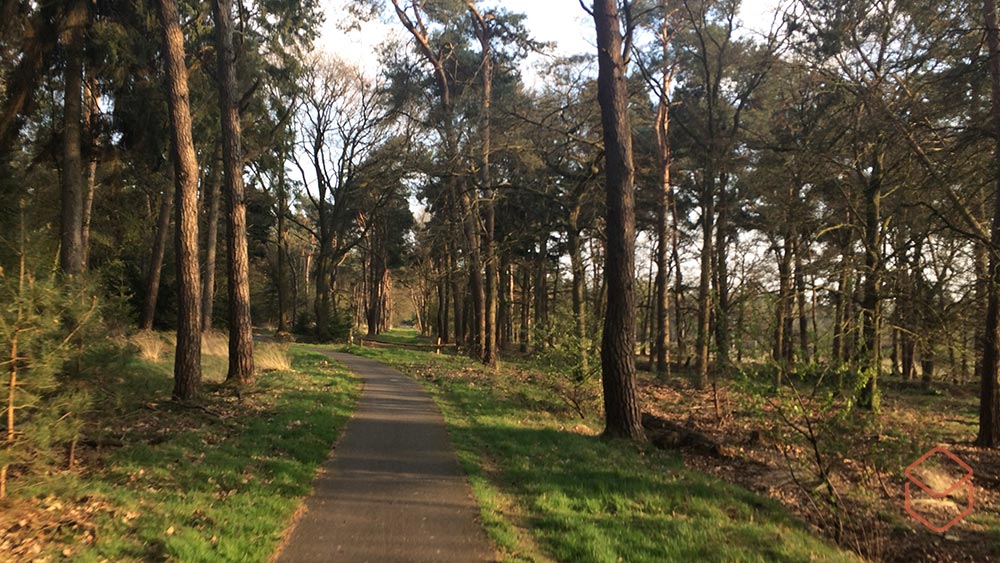
Interesting! To me the best bike "lanes" are not lanes at all, they are bike paths through the Forrest, no cars allowed or even in sight. Paths like this [0]. The air is clean, it's safe and relaxing. When taking my kids to school I go over such bike paths, it's nice, I don't have to worry so much about the kids. Then we hit the road again, I'm breathing fumes, I keep telling my kids to stay at the side, tell them exactly where to brake and cross the road... We should separate cars from bikes as much as possible.
Yes, but this can be used as an argument against supporting bicycles for commuting. E.g., "We will build recreational bike paths in the forest so streets can be kept for cars. We need to keep cars and bikes separate."
So, I personally believe that building brick roads with bike lanes in dense areas is a great solution. With brick, cars naturally slow and people naturally shop more.
I think this idea can be transferred to cities. To me the best bike network is one that is independent of the road network. Look at the 606 or lake front path in Chicago.
Look at Boulder Colorado which has an extensive network where many of the paths hug the creek running through the city.
The easiest place to start in most cities is to just build paths along rivers and streams that go beneath or above roads.
Yeah there are cities that build along rivers and streams, but we really need a cycle network built for connecting residential areas with employers via a direct path, the way we build roads.
>The design principle of separating cycling and walking from car traffic has been pushed to the limit. Houten is unique in this. Cycling comfort and safety are extremely high (optimal), even by Dutch standards. A large network of bike paths makes it convenient to cycle to various destinations and within the town the bike is the most popular means of transport.
> The city of Houten is known as, nationally and internationally, and in growing interest from home and abroad, as the worlds best practical example for bicycle friendliness. A growing number of groups with politicians, developers, designers and students visit cycling city Houten for study purposes and inspiration.
This sort of thing is a big part of why places like Houten (and Odense - basically second or third tier cities with good infra but lower cost of living than capitals) are on our short list.
When was the last time houses were demolished in a city for building more roads? We should treat space for traffic infrastructure as a fixed supply and take away space from cars for building cycling infrastructure. Building paths along rivers or through parks or such is almost always completely useless for commuters. Existing roads define the efficient connections between places people want to go. If you want cycling infrastructure that people use, you either need to put it where the roads are, or demolish housing to build new efficient routes.
Been commuting daily through forests in different parts of Europe and had no problem, people regularly walked to work through the same paths. What's your concern?
We've played nice for decades and motorists have kept causing thousands of preventable deaths and show no signs of stopping. At some point we have to stop pretending these negligent homicides are "accidents".
People are self-centered assholes and this is reflected in their driving. An “accident” is an innocent, honest mistake. Incidents involving vehicles and pedestrians are cyclists are closer to negligence than an innocent mistake.
I meant more generally. Drivers get off very easily for very poor behavior that is often negligent and sometimes maliciously so, especially in their treatment of pedestrians and cyclists.
If I get hurt or killed because you're either careless or not experienced enough to drive a heavy vehicle what's the alternative solution you have in mind?
The legal infrastructure you suggest absolutely works to reduce accidents and increase driver responsibility. When I'm driving in the Netherlands I am critically more aware of cyclists there, due to the road layout but also because of assumed liability, I'd better be 100% sure I'm driving safely.
This is my perspective, I exclusively bike to get around. We can play out the premise described by the OP, and it just doesn't add up.
If some schmuck with California's minimum $15,000 per person injury insurance disables you, what would you do? Sue them for their additional median $97,300 net worth? Which might be less than $10,000 liquidated? That is you'd expect to get, somewhere between $25,000 and $112,300, for your lifetime injury. Perfect enforcement with 100% liability legal system would get you $25,000-$112,300 in my estimate, for the rest of your life. If you're permanently disabled, it's peanuts.
It's a shitty outcome. The problem is in part, clearly, that people are really poor.
And then suppose it's a totally recoverable injury. Out of $112,300 you recover $25,000, realistically, and the driver is bankrupted. You could put a whole family on the street. It's not Europe, they will go on the street! Is that justice? They're all completely broke dude. They have nothing besides their car.
People are living paycheck to paycheck, and you're comparing European countries where neither disability nor bankruptcy condemns you to a life of poverty. 20% of Americans claim some disability. 20% of Americans have zero or negative net worth, which is 4x the EU + UK's 5%. You have a 1 in 5 chance of getting hit by someone in their car, and recovering a maximum of $15,000, or $0 if they're uninsured.
The simplest answer is that only people who are rich enough to pay the remedies of death by vehicle accidents should drive. That can be as simple as either requiring self-insurance (i.e., you must have a net worth more comparable to death settlements, or $500k-1m), or at least an insurance that covers that kind of injury (which poor would not be able to afford). I don't think that sounds like justice either, think how disruptive it would be if you had to be that rich to drive? It would certainly impact rich people too, because they'd be underwriting their nannies, cooks and, checking my notes, teachers, firemen, nurses, etc. to get to work.
It's pretty crazy too, the degree of wrong in the comments to this. At least bring some facts to this discussion. People are just trying to survive, of course they are going to go with the cheapest possible lowest coverage insurance. On top of that, "about 15% of California drivers have no insurance, according to the Insurance Research Council." (1) Like what do you think those people with negative net worth (20% of Americans) are doing? Buying $2,000/yr auto insurance policies? It boggles the mind.
This is a bad way to look at the numbers. In urban areas, cycles are on average below median income, and drivers are above to far above median income. Yes, there are poor americans, they are by and large not driving cars in urban areas, wealthy folks are on balance driving cars, and the poor people are riding bikes. Laws that shift monetary risk from bicyclists to cars are progressive policy.
Even in Seattle there are a plethora of super-commuters who drive from Auburn, Enumclaw, Issaquah, north of Marysville, etc every day in 15+ year old cars as it is cheaper to drive and park in the city than take to commute via another means or pay to live close to work.
The fact that there are poor people that drive does not take away from the fact that the median cyclist income is always lower than the median driver income in all US urban areas so any policy that distributes risk in the form of liability from cyclists to drivers is progressive.
Damn, those numbers are wild. In Canada, my insurance company won’t provide less than $1m liability insurance, and the gov’t requires a minimum of $200k in coverage.
I was confused about this for a long time. In the UK liability coverage seems to be intended to pay for the harm, so my last UK insurance had 12M GBP of cover if I remember correctly (and after that limits were removed I believe). In the US it is intended to cover your net worth so if you are sued you don't lose anything so when I first moved here and opted for $1Mn they told me I was over insured.
>> The simplest answer is that only people who are rich enough to pay the remedies of death by vehicle accidents should drive.
This is the duuuummmbest shit I have ever heard, and reeks of someone who has no idea just how large the United States is. I'm sure this works great in a tiny nation where everything you want to access is within a click or two, but there are parts of the United States where people literally have to drive an hour or more (at 60-70 mph) to get to a grocery store.
I have a friend who retired to Wolf Point, Montana. The nearest Walmart is five hours away. The only thing there is an Albertson's, which is frequently sold out of items.
My favorite thing to do with my European colleagues and friends is drive them around Texas when they arrive. Many of them quickly pick up on an expression that is common across almost all of America - "Oh, its just right down the road."
"Right down the road" in America means "its anywhere from 5-30 miles away". It doesn't mean, "its 600 meters down the street". And they all pick up on it.
Do you know what the problem with "simple" answers are? They're childish. There are no simple answers in life. Everything exists in a state of extraordinary complexity and requires significant consideration. Don't believe that? Look at how we've handled the maintenance of the National Park Service in America. One environmental disaster after another.
I’m a cyclist and driver too, and I always get annoyed when cyclists always blame the cars. Most cyclist don’t follow the laws and then yell at you for their fault. I stopped my bike at a stop sign, the dude behind me wasn’t prepared for it and hit me with his bike. He then yelled at me for stopping. Honestly, both drivers and cyclists are rude and selfish on the road.
To be fair, where I live the cars don't stop at signs either. A typical reaction when I stop (in a car in front of them) is to flip me off and honk or speed past in the wrong lane.
The difference is that when a cyclist is rude and selfish, it might put you in a bad mood for the rest of the morning. When a driver is rude and selfish, cyclists can die.
I'm so sick of this "but cyclists are mean too!" whataboutism in every thread of this nature.
In addition the rules and streets themselves often don't make that much sense for cyclists. If the situation was similar for cars you'd see them behave very differently as well.
> The difference is that when a cyclist is rude and selfish, it might put you in a bad mood for the rest of the morning.
Had a cyclist illegally cross horizontal to a lane on a 40mph road, almost resulted in a 3 car collision - luckily all three drivers (including me and the car behind me) were paying attention.
A cyclist absolutely can cause deaths by not obeying the laws of the road.
What you're really saying here is that cars are so inherently dangerous that they amplify unlikely-to-be-deadly mistakes from other road users into events that are very likely to be deadly.
That said, when I am driving, I have absolutely no issue with people on bicycles who ride predictably and follow the rules. It's those who don't that anger me. Specifically, I'm talking about things like riding through a crosswalk, riding the wrong way, and not signaling lane changes. There's a reason you're supposed to walk your bike through a crosswalk, and not signaling when you're a ~200 lb driver + rider combo facing down vehicles weighing more than 10x and capable of going much, much faster than you is just dumb.
That doesn't mean drivers aren't dumb, too. On top of the usual traffic BS we all deal with while driving, I also see a lot of instances of drivers not taking over a bike lane when turning. Usually, in this case, this just seems to lead to a lot of "go! no, you go! no you go!" business, but it's 100% a recipe for a crash.
While there’s a valid point to be made about expecting cyclists to behave, one also needs to consider that the vast majority of infrastructure in the US is for cars. Lights often don’t respond for cyclists, for example. If you were driving your car and you needed to get out of your car and walk over a nearby light standard and then get back in your car whenever you wanted to use a lighted intersection, how long would you go on before concluding that this was a waste of your time and start crossing when there is a large enough gap in traffic instead?
Another thing to consider is that bicyclists behaving badly are almost always only a risk to themselves, while drivers behaving badly are a risk to others. You can’t compare the two.
Cyclists can absolutely cause car accidents and get people killed. A cyclist on the road (in the US) is a vehicle and is expected to act like one, which means following all traffic control devices and signs.
Sure. But I’m a busy guy and I’m trying to stick to a proportional amount of rage for each mode, based on how much damage they inflict on others. How many of the 30k roadway deaths per year (in the US) do you think we can attribute to scofflaw bicyclists putting others at risk?
Because people on the internet are pointing out two things that are commonly compared, and then adding further details to argue why they should not be compared.
I have no problem with that if it's done safely. But, I've had people try to blow through an intersection when I'm turning at a protected left. That's just asking to be hit.
As a driver, cyclist, and pedestrian, I'm reasonably confident that virtually 100% of collisions involving a car and a pedestrian or cyclist involves real mistakes by the driver. I use the 6 year old rule. If a 6 year old ran (or cycled) recklessly into the street would you hit them? If so, you're not driving safely.
Well obviously if your standard of who is at fault is "the driver is always at fault", obviously 100% of collisions are going to be the fault of the driver.
This will partly depend on the type of highway you have in mind. And even so, it most probably depends on local laws, so the following is applicable in most European countries, AFAIK.
With that caveat, on access-controlled highways (motorways), you’re not allowed to walk, so any pedestrian would be in the wrong for being there. That said, even there a driver would be at fault for colliding with a human (policeman, fireman, people after a car accident, and other people who might have a very good reason to be there) regardless of what that human was doing. It’s not that different from crashing into a stopped car or any other kind of obstacle. Similarly, a driver is at fault for hitting an animal.
In non-access controlled highways, the driver would be at fault if their car collided with anything, be it another car, a human, or an animal. How legal it is for a pedestrian to cross in this case depends on local laws.
So in any case, yes, the driver is responsible, although that responsibility could be shared in some cases. If the accident results from deliberate action on the part of the pedestrian, there probably would not be any consequences for the driver in any lawsuit (unless the driver was also reckless or drunk), but for insurance purposes it does not matter.
If I see a 6 year old on a roadway, on bicycle or on foot, I would stop, or at least slow to a crawl. I will then wait until they get back to sidewalk before driving normally.
This is not the case with bicycles - they drive with the traffic, as a part of traffic. So I don't think this rule is very applicable to real world.
Slowing to "a crawl" with six year old in front of you would likely kill them. I don't think your judgement is one people should trust and I certainly hope this hasn't happened yet in actuality.
Who said anything about “in front”? You slow down to a crawl if they are close to you. Like riding in the bike lane parallel to you. Or even catching to you up from behind. Or standing on the opposite lane of road.
That’s what I am trying to say: with kids, even if they are nowhere in your path, you want to slow down anyway, because who knows.
This rule does applies less to adult bicyclists. For example, if there is a separate, dedicated bike lane and there is an adult bicyclist there, I will pass him. Not so with kids.
A statement of the form "I am XXX" requires no citation. I doubt there are many who have done a more comprehensive study than AdamN of what it is like to be them.
For whatever it's worth, I would agree. I am confident that most cyclist/car accidents will be the car driver's fault. Would you even be surprised, if this turns out to be genuinely the case? I wouldn't! Do you even drive a car? I do! Car drivers are shits - or at least behave exactly like them - one for the philosphers, perhaps - and I cannot fathom how anybody that drives a car could think otherwise. Have you not noticed how these people behave? (Sure, lie to us all you like - but don't lie to yourself!) Car drivers would run your kids down, and you know it, if it would save them 5 seconds - then in court they'd cry about how things are so difficult for them now they're facing prison. Because they know they'd probably get away with it.
Out of the tiny number of times an accident is the cyclist's fault, the vast majority could be avoided if the driver was paying an appropriate amount of attention - and the 6-year-old rule of thumb is a good one, I think, when it comes to gauging how much attention is appropriate - given they're driving a 1500+ kg 200+ bhp murder machine, a major design goal of which is ensuring its occupants come out unscathed from any collision.
I am confident the remainder could be dealt with on a case by case basis.
Sigh. You may not realize this, but when someone says "I am reasonably certain that X," they are not, in fact, generally asserting their certainty. They are, in fact, asserting X to be true.
So, to your "I'm confident that..." I also say: citation needed.
> You may not realize this, but when someone says "I am reasonably certain that X," they are not, in fact, generally asserting their certainty. They are, in fact, asserting X to be true.
No, they are claiming that they have a belief (implicitly, often, a justified belief) that X has a high probability of being true, unlike stating merely “X” which denotatively is a claim that X is true without qualification.
Accident statistics in Berlin show that in accidents involving motor vehicles and cyclists, the motor vehicle is at fault about 2/3rds of the time. The ratio is a lot worse if you restrict it to trucks. It's also worse if you restrict it to accidents causing serious injury (a lot of accidents caused by cyclists happen while filtering through a line of stopped cars and touching a mirror).
They are a google search away. I mentioned Berlin because I live there and looked at them before. I guess cyclists do these maneuvers because they're legal and standing at the back of a queue of cars is not a safe place to be for a cyclist. I'd rather touch a mirror and fall than be rear-ended by an inattentive driver.
Another example is one-way traffic signs. They are positioned for drivers which means that they are low enough to easily be missed by cyclists whose sitting positions are higher up.
Seattle streets in a nutshell. As a frequent pedestrian I've lost count of the number of times a car has stopped in the middle of an intersection and frantically tried to wave me across a street. Some people are just bonkers. If you're already inside an intersection, don't yield to a pedestrian who's standing still on the sidewalk! Are people trying to get t-boned? Worse, in those situations I feel morally compelled to run across the street just so the driver will remove themselves from the dangerous situation they put themselves in for my sake. Absolutely infuriating.
Pedestrians behave unpredictably. And they're often pretty isolated from their surroundings these days. I don't really disagree with you but the driver has probably also seen a pedestrian obliviously walk into an intersection like that.
If the pedestrian seems oblivious that's one thing, but if the pedestrian is staring you in the eyes and is broadcasting 'what the fuck are you doing?!?' body language and gestures, I don't see much excuse.
Turn and face away from the street to forcibly yield right of way.
Drivers blowing through crosswalks (especially unmarked crosswalks) are far more common, to the point that it's unsafe to make a mandatory stop on a two lane per side road, because that risks killing the pedestrian when a driver in the second (left) lane illegally zooms past the stopped car and hits the nearly invisible pedestrian.
Usually this sort of thing is grassroots and ooorly funded - but just imagine what the enormous financial resources of the self-driving car industry could do - by increasing the costs and deadly perception of human car driving in every city that say Uber operates in,
the likelihood of those jurisdictions approving even stage 4 cars on the road will increase.
Just hire the same lawyers that the tobacco industry was paying.
I should send someone a memo
Having said this, (as a daily commute cyclist pre covid) the issue is lack of delegated infrastructure- and I think that applies not just for mixed human drivers and human cyclists but (as much as it disappoints) we will likely need separate roads for self driving cars and human (cars / bikes / pedestrians).
Self driving seems a really hard problem now we are past the "california highway" level. To be safe at night or in rain or in Italian backstreets or Mumbai rush hour seems behind reach.
So we can use infrastructure to reduce the need for better AI. But that gets expensive. We can probably avoid building a second road network - but we need compromises.
Separated bike lanes will help this - those great wide Dutch streets with pedestrian bike car and the tram lanes come to mind - main roads where the central lanes are for automated use only.
The cost will be enormous (and blows most business models out the water) but we may win elsewhere - reclaiming some of the streets back as living areas, migrating deliveries off trucks and into smaller slower delivery vehicles designed to trundle down thinner streets.
Either way i look forward to a future of slower vehicles a d bike paths
I don't disagree, but I do wish there was a more formalized way to educate both bikers and drivers on the laws. I just saw the Washington DC official bike map has the laws on it, but others do not. And what use are the laws if the drivers don't know them? Both bikers and drivers need to know them to be successful.
I've asked a good number of both bikers and drivers in my area and they don't know that the laws exist:
A driver must move over to the next lane if it is open and a biker is in the bike lane or the lane the driver is in.
A driver must not pass closer than 3 feet from a biker
A biker may take an entire lane and ride two wide
I think if drivers knew that the above rules, and it became a norm to take the entire lane when 3 feet was impossible based on the size of the lane, then biking would be safer.
To not leave this as a "this is bad" without proposing how to fix it... the education could be incorporated into gaining your drivers license, city sponsored advertisements, or having police actively spend a period of time enforcing the above laws (warnings would be fine, more for education than penalty)... or all 3.
> I think the only way forward for cyclists is intense litigation
In my (non-cycling-related) experience, this is never true. That is, litigation gets you little, if anything. If there is no public, political way forward (inside or outside the political establishment), then you're stuck, and had better work on that.
Ideas:
* Promote use of public mass-transit instead of private cars (e.g. via infrastructure and mass transit investiment)
* De-motivate use of private cars (e.g. through taxation on car purchases and/or on gasoline, stricter pollution regulation, more expensive parking)
* Change the law so that in all cyclist-car-driver accidents, the car driver is at fault unless he proves otherwise.
This all requires a lot of public pressure, which in turn requires public opinion work through local advocacy.
---
Alternatively, some people could go the vigilante way. I'm not advocating this, but in theory, acquaintance of the cyclist victim of an attack by a car driver can retaliate either immediately or ex-post-facto, not within the bounds of the law. That could mean something like a scratching a rebuke on the car's paint, or pasting a piece of material with a written message to the front window in a way which doesn't come off easily, or blocking the car from leaving its parking spot with some kind of inconvenience, together with a rebuke that is easy to remove (e.g. page of paper under windshield); etc.
This route does not require mass active support across a country or legislative district; it only requires passive local support for cycling and disdain for car drivers hitting cyclists - enough to create multiple potential suspects while making it very difficult for law enforcement to pin the actions on any one of them. i.e. if people in the same neighborhood don't rat them out.
I believe the solution is education. It's ridiculous that people are allowed to drive cars before being able to use the road. Airline pilots learn by building up hours in a small aircraft during the day. Then they learn at night. Then they move to larger aircraft.
It should be mandatory to learn to use the road on bicycle before even applying for a car licence. The biggest problem I see is that people simply don't know what it's like to use the road outside of a car. Neither on foot nor on a bike. Dashboard perspective is a real thing. It makes you see other people as obstacles rather than people who are just trying to go to work or return to their family, like you.
Requiring bicycle training would dramatically increase the number of cyclists on the road, essentially taking it back from the tyranny of motorcars. It would also ensure that those who do decide to learn to drive have the experience necessary to be a good road user. Additionally, if they do end up causing an accident the licence can be revoked and they can get back on the bike.
Also sue cities. It's not always possible because of liability constraints for government entities, but sometimes victims of traffic violence can demonstrate negligence and get a foothold into a liability case. City officials often pay little more than lip service to constituents, but they pay attention to risk managers.
Even better, or worse, you have to make it into a lawyer industry where they start putting ads on billboards. Then you will really hyper charge it and insurance companies will start acting accordingly. Hell there might be changes to cars themselves to reduce their insurance costs in some vague future.
Call me crazy, but as a runner I’ve thought of getting one of those follow drones for documenting trails... but what about as a “dash cam” for cyclists? You would certainly be able to get evidence of the sort of thing you are describing.
Where I live it is illegal to use dashcams for this purpose,
whether on cars or bicycles. If you do it and give another
reason that's fine, but it will still not be accepted as
evidence in court. The rarity of good bike lanes does not
improve the situation either.
I can't speak for the parent poster but here in Sweden it required a ruling by the Supreme Court to determine that dash cams should be legal. Until then the footage was inadmissible as evidence, as far as I'm aware, because it was effectively seen as illegal surveillance.
In NL, world famous for its cyclist-friendly policies, whenever there is a car / bicycle collision, the car driver is ALWAYS responsible, even if the cyclist ignored a red light or whatever. The driver will always be safe, but they are operating heavy machinery, so it's up to them to keep safety of the more vulnerable road users in mind.
That said, around where I live, car / cyclist collisions are still pretty frequent; I live in an area with a lot of roundabouts where cyclists have right-of-way, but because of angles, darkness, rain etc, visibility of cyclists is often very low.
I believe bicycles are purposely devoid of rights by the automobile industry lobby to get people to go through all the pain of buying and owning a car. It's painful, and people hate it, but they do it because there's no other good way to get from point A to point B in America.
Some examples:
1) I suspect the "new car smell" that car buyers believe affects their judgment is purposely chosen glue (I think it's a glue) that dissipates into a gas that literally, psychiatrically impairs buyer's judgment. It's real. [edit: it's still relatively mild].
2) Stealing a person's main means of transport should be punished independently of how expensive that mode of transport is. So, the penalty for stealing a car should be based on the price of a car and the fact it was the main means of transport for that person. Same goes for bicycles, it could have been a $100 bike, but it's the main means of transport and that person is equally stranded as the driver without it. For this reason, being a bike thief stealing 10 bicycles could mean a decade in jail, if laws were different. Who would steal bikes then?
3) Enforce both car driving violations and bike driving violations, but based on lethality of the vehicle. Right now both driving a car drunk and riding a bike drunk are a DUI, which is ridiculous.
4) Legislation that privileges driving over biking harms children, because they can ride a bike starting age 8 or so, but can't drive until 16.
5) Driving is an extremely lethal activity, but AFAIK biking deaths are mostly attributable to automobiles. If you try to run someone over with a car you can be charged with (I forget the wording but more or less) "using a deadly weapon". Because that's what it is. A killing machine.
I like the rules in China. If you are driving a car and collide with a bicycle, it is presumed to be your fault. If you are riding a bicycle and collide with a pedestrian, it is presumed to be your fault.
Of course, just like everything about driving in China, the rules mean very little. It's pretty hard to enforce your rights if you're dead.
My ten-years-old experience driving there was interesting. At any given time you could expect the cars around you to do the stupidest of all possible things, completely ignoring the rules. But they'd do it slowly, and expect others to adapt...which they did.
Doesn't China also have the problem where helping the victim is considered an admission of guilt / attempt to over up, because an innocent person wouldn't give of themself to help?
If you try to run someone down, and end up killing them, that would be considered murder. If you try, but don't end up killing them, it would be assault with a deadly weapon at the very least, or possibly attempted murder. If you just so happen to kill someone without intending to, it could be considered vehicular manslaughter.
At least where I live, you can get "vehicular manslaughter" for intentionally running over a cyclist. It's easier to give a murderer a plea deal for a lesser charge so you don't have to take the time to convict them and prove it was intentional. (https://www.nbclosangeles.com/news/local/claremont-woman-who...)
> If you just so happen to kill someone without intending to, it could be considered vehicular manslaughter.
There's an additional constraint of acting negligently. If you're going 45 on a road where the speed limit is fifty and someone sprints out in front of your car, you won't be convicted of vehicular manslaughter (assuming obviously that you didn't have time to react).
Right, that's why the word "could" is in there. All of the crimes I mentioned have an element of either intent or fault attached to them. Coming close to someone, even at speed, without intending to do any harm is not "attempted murder" or assault in any form. This is fortunate, because to pass a cyclist, one often is forced to come within a few feet of them to accomplish the maneuver.
... to pass a cyclist, one often is forced to come within a few feet of them to accomplish the maneuver.
Somehow I'm reading "within a few feet" as "six inches". IME bicycles are much narrower than automobiles. If it's safe to pass an automobile, it's safe to pass a cyclist while leaving at least eight feet.
I'm biased by experience. Why did you write "within"? Three feet is an acceptable distance to allow if you're traveling less than 40mph. Less than three feet is not.
This seems beside the point? Above you seemed to imply it is inherently challenging to pass a cyclist. That is only the case if one attempts to pass in inappropriate situations. Cyclists have at least as much right to the road as motorists have.
Yeah, I think that's the phrase I'm looking for, "assault with a deadly weapon". Happens a lot when marriages break up, from what the person who introduced me to the term described, divorcées-to-be chasing their husbands down in their cars.
We talk so much in America about gun control, why not also car control?
Drunk driving also used to just be something that happens, not taboo or enforced much, until a huge cultural and law enforcement change happened. It will take something similar to finally make it not ok for cars to run over cyclists.
Cyclist as well - the group I ride with jokes (in a very dark way) about how if we ever wanted someone dead without getting in any real trouble we’d invite them on a bike ride and have someone we know run them over with a car. Easy!
So are people in the Netherlands inherently much more caring than people in the US? Or do people, consciously or otherwise, actually care a lot more about monetary liability than causing the deaths of others?
I refuse to believe that people care more about the monetary and legal consequences of killing another person than the moral aspect.
Hypothesis: Dutch drivers are more careful around cyclists primarily because everyone rides a bicycle themselves. Knowing what it's like riding a bicycle in heavy traffic makes you a more careful driver.
> Unfortunately, I think the only way forward for cyclists is intense litigation against both cities and drivers around car collisions.
Do you want ANTI-bike laws that ban bikes from everywhere not permitted? To someone rich, the "solution" to having to deal with bike liability is to ban bikes.
The only solution is separate bicycle and car infrastructure. Period.
Yes, it sucks that San Francisco has backed off separate infrastructure due to budget. However, the solution is to go lobby SF and to make pro-bike infrastructure a single vote issue to make them put it back.
One thing I do not understand: why hasn't some rich millionaire/billionaire taken some second/third tier city and funded bike infrastructure into it? It seems like it would be a lot easier to get bikers to move to a city that has infrastructure rather than trying to jam infrastructure into city that is basically land-locked/water-locked.
The problem is right now in SF we have a strong bike lobby and we vote and it still isn’t enough. The idea that voting with a block is a way to forward policy goals in 2020 is quaint TBH. As far as I can tell pretty much all successful political movements in the US (NRA/guns rights, marriage equality etc) have made the most material progress with both direct action (protests) and lawsuits despite both movements being electorally unpopular and having no electoral success at the time of their greatest achievements. Voting is a necessary but insufficient ingredient in policy change and has never been the silver bullet centrist democrats claim it to be. We need to add some legal adventureism to the mix to push the ball forward here both through expanding common law in friendly ways against car centric policies as well as just making it more costly to not have bike lanes than to construct them for the city and its residents.
The reason why I sometimes treat traffic lights as stop signs is because I'm worried the driver coming up to the red light might be distracted by their phone and run right into me. This has happened to two of my friends.
So my seemingly disregard of the traffic laws is often to put more space between me and heavier vehicles.
However if car and I end up at a four-way stop at the same time, I'll let the car go first because I don't trust that driver saw me.
With driving a two-ton vehicle should come more responsibility and attention, but Americans view driving as a God given right.
> The reason why I sometimes treat traffic lights as stop signs is because I'm worried the driver coming up to the light might be distracted by their phone and run right into me. As has happened to two of my friends.
This is something motorcyclists need to be hyper-aware of too. Same idea approaching yellow lights. Here’s a scenario that happens all the time: you’re coming up on a yellow. There’s a car in the intersection ahead waiting to make a left into your path. The car behind you isn’t slowing down, he either isn’t paying attention or wants to run the yellow. What do you do to stay alive?
The right answer is to act earlier to avoid that situation in the first place, but there will be times when you find yourself in a bad spot.
The problem is the guy who wants to turn left into your path. On a bike, you have no idea whether or not he sees you. Even eye contact isn’t a good indicator.
It can seem like a non-issue, but it really isn’t. Drivers’ eyes are trained by experience to recognize other cars. From a driver’s point of view, an approaching bike (motor or otherwise) is a narrow vertical line that has very little apparent motion. Even if they see you, it’s really hard for an oncoming driver to gauge your speed.
There are things you can do to make yourself more visible, like swerve a little in your lane. This gives you some lateral motion that makes you pop out of the background.
The point is that on two wheels you face situations that four wheel drivers don’t think about or understand because they take their visibility for granted.
You're confusing the letter of the law with enforcement.
Most drivers break the law every day in ways that are much more dangerous than a cyclist running a stop sign.
Let's consider speeding, one of the most dangerous and commonplace of traffic violations. Drivers are rarely penalized for it, despite its potential lethality.
On the other hand, it is relatively easy for a cyclist to clear an intersection due to a bicycle's slower speed and better field-of-vision.
Perhaps it's best to leave this issue to cyclists; most cyclists are drivers, but very few drivers are cyclists. And it shows.
IMO the answer is to have registration and insurance for bikes, which would create financial incentives to drive reporting and behavior.
In the limited experience that I have as a frequent pedestrian visitor with dedicated cycling lanes in NYC, they feel dangerous to pedestrians. Many cyclists don’t want to stop or yield to pedestrians, and left turn markings on avenues are still evolving and confuse a lot of drivers.
I’m not sure where you live, but here in Ohio cycling is definitely not “well established”. When you compare infrastructure it’s not even a competition. Don’t want to deal with bicyclists breaking laws? Get them off the streets onto their own dedicated infrastructure. Then bicycling actually would become well established.
“Big bills” do nothing to stop drivers from breaking the laws, but go on thinking that it will change cyclists.
Since most cyclists in the US also have car insurance, our rates could be based on computing the risk of each mode of transportation. Cyclists would pay less for insurance. Make my day.
Where I live, bikes are considered vehicles, like cars or trucks. It makes complete sense to me that you'd need to be licensed to operate a vehicle -- any vehicle -- on public roads. In this thread about how dangerous it is to ride a bike in cities, I'd love to hear an explanation for why we think it's a good idea for anybody to hop on a bike and ride in traffic with no training, no oversight, no insurance, and no registration.
Cyclists aren't exposed to the same liabilities. They don't typically cause death or injury to others when they fuck up, nor do they cause thousands of dollars in property damage.
Unfortunately, many cyclists stake stupid risks which also cause accidents. I have seen stoped cycling between rows of parked cars and darting through a red light, or going full speed down a sidewalk past rows of parking garages etc. Without dash cams it’s nearly impossible to tell the root cause as reckless driver or a suicidal cyclist.
This is why both drivers and cyclists really should be recording things. It doesn’t prevent injuries, if it can make a huge difference afterwards.
I meant stoped cars at a stop light. Which should have been clear from context as you don’t normally get rows of parked cars on public streets. Anyway, that and other instances of sharing a lane beside a car is monumentally stupid.
The only way to fight stereotypes like this is with hard evidence.
Preliminary results from a study in the United Kingdom, conducted by the University of Nottingham for the Department for Transport, show that filtering is responsible for around 5% of motorcycle Killed or Seriously Injured (KSI) accidents. Bicycle statistics are harder to come by.
But sure it’s “perfectly safe” and even occasionally legal. Frankly the number of people defending this practice is a significant sign it’s a real problem.
Are those motorcycles zooming between cars at high speeds? Is that comparable to a cyclist?
And filtering to get in front in the intersection is safer for a cyclist, as one is then better seen. So no reason not to filter through stopped traffic, really. If it's a safety issue, the solution is probably to remove those making it dangerous (cars) from the streets.
No “filtering” specifically refers to stopped traffic.
The solution is to simply avoid trying to share a lane while sitting in people’s blind spots. Someone can easily get between two rows of cars turning left without realizing it and get knocked over even when the cars are doing everything correctly.
The same is true of sharing lanes even on city streets, lanes simply are not wide enough to safely share as the motorcycle or cyclist has vastly reduced visibility and may miss construction lane markings etc that unexpectedly move traffic.
> I meant stoped cars at a stop light. That and other instances of sharing a lane beside a car is monumentally stupid.
Ironically the point of this article is how this is always permitted and the sole reason sharrows exist is to point it out. Judging by your comment it isn't widely understood.
No this is really not about that, cyclists are always allowed to take up the full lane in cities, but it’s rarely legal to split a lane, and even then it’s a terrible idea.
Preliminary results from a study in the United Kingdom, conducted by the University of Nottingham for the Department for Transport, show that filtering is responsible for around 5% of motorcycle Killed or Seriously Injured (KSI) accidents. (Bicycle statistics are harder to locate.)
I don't think motorcycle data on lane splitting is particularly relevant, because motorcycles are able to keep up with traffic.
If a cyclist can't lane-split, then what are they supposed to do up a hill? If they take the entire lane drivers get annoyed, if they don't take the entire lane (and follow the common guideline of riding as close to the edge as safe and practical) then you claim they are doing the wrong thing too?
Honestly, as a driver and pedestrian, I don’t have a lot of sympathy for bicyclists. In my city, at least, I’ve almost been hit by cyclists multiple times as a pedestrian. In one case, the cyclist was going the wrong way, blatantly ran the light, and screamed at me as he passed within maybe two-three feet of me at full speed while I was crossing the street.
In another case, a cyclist blew by my at full speed down a steep hill on the sidewalk, again coming stupidly close to an accident (for both of us) for no reason.
As a driver, I constantly see cyclists on the wrong side of the street, back and forth between the sidewalk and not, and not obeying stop signs or stop lights (let alone other rules). I’ve never even heard of one being ticketed.
I’m all for new bike lanes that are separated from traffic. But honestly before a city encourages more bike riders I really think they need to dramatically step up enforcement of traffic laws against them. If running a red light or stop sign is a $200 ticket in a car, it should be a $200 ticket on a bike. Otherwise it is just unsafe for everyone involved.
> If running a red light or stop sign is a $200 ticket in a car, it should be a $200 ticket on a bike.
Curiously; in France many red-lights are excepted for bicycles. There's often a special, permanent "orange" signal that applies to bikes, thus they are explicitly encouraged to run the red light. If I understand well, this was in agreement with drivers, who were annoyed to wait for all the bikes to start slowly after the light turns green.
I think that if you ever try to use a bicycle in transit (I mean, seriously over a few days, not for 5 minutes), you will see that it is essentially impossible to do correctly. Sometimes you have to turn left across many lanes of fast cars, what are you supposed to do? Inevitably you take the least dangerous path.
I rode a bike as my sole form of transportation for a few years. it's not "impossible" to do correctly, but it may be impossible to do without exceeding the amount of effort you're willing to exert.
> Sometimes you have to turn left across many lanes of fast cars, what are you supposed to do?
one of the great things about biking is that you get to pick and choose between car rules and pedestrian rules depending on which set fits the situation best. whenever I am uncomfortable making a left turn, I pull off to the right and cross the intersection like a pedestrian.
> one of the great things about biking is that you get to pick and choose between car rules and pedestrian rules
Oh, I hate that! Bikes are transit, and are not supposed to leave the transit in the middle of their way, especially not for negotiating an intersection. Bailing out of the bike and going on foot with the pedestrians does not count as "doing the correct thing", just that using the bike is impossible. Besides, it is annoying for the pedestrians.
> If running a red light or stop sign is a $200 ticket in a car, it should be a $200 ticket on a bike.
Hard to justify when safety is the main argument. Yeah, $200 fine for cyclists would be a good deterrent, but maybe then it should be a $1000 or $2000 fine for a car doing the same thing [0].
If you want to argue that cyclists should face the same penalties as drivers, you have to make an argument prioritizing safety, but something like "respect for the law".
[0] Or - $200 plus points on your license. That's the way it works in many jurisdictions: the motorist rightly faces a bigger penalty even though the top-line dollar amount is the same.
Cars took over the bicycle infrastructure; if we had dedicated bike infrastructure as we do for cars I think you'd see things a lot better. Sure there are self-righteous creeps in every subculture, but a lot of the things you see are consequences of adapting to a dangerous environment maladapted for bike use.
Bike infrastructure in a lot of European cities demonstrates that it can work. American drivers are much more polite than European ones yet kill more cyclists per capita.
By that logic, should the fines car drivers face scale with the weight of their vehicle? Is blowing through a redlight in a small sports car a lesser crime than doing the same with a large pickup truck?
I'm receptive to this, but I doubt it would ever be implemented.
The fines probably do scale up as the class of the vehicle scales up. In large because you can lose your job if you are a bus or truck driver and do this.
It’s not like (most) cars will run over the bicycles and just keep driving.
If one is driving, and a bicycle runs the red light and jumps in front of them, they’ll hard brake (at least most of the people). This means they have a very high chance of being rear-ended by the next car, and if the driver is not very experienced, then can lost control and hit other lane / objects and people at the side of the road.
As a similar example, we don’t allow untrained and unprotected people into construction sites with heavy machinery. Saying “hey, let me walk under this pile driver, it is my life on the line!” isn”t going to cut it in the US.
No, they are "the same crime" (failure to stop for a red light), it is one and the same law that applies to both, therefore the "crime" is the same. Therefore the penalty should be the same amount as long as the same statute applies.
Now, if you prefer the penalty to differ due to the potential for injury, you need to get the politicians to change the laws so they are not the same crime, or so that the penalty scales due to some formula in the law related to the potential for injury.
A cyclist can cause harm to themself and rarely one other person while running a red light, a car driver can cause mass casualties while running a red light. Difference of scale.
you can cause a large amount of harm at any time by doing something unexpected on a public road. doesn't matter whether you are a driver, cyclist, or pedestrian.
The traffic rules are there to avoid all sorts of incidents, you can't excuse yourself out with "scale". If you kill yourself running red, it is still a fatal road accident at the end of the day.
1. Your lack of sympathy comes from false generalizations about cyclist behavior. You tend to remember the egregious behavior and likely give a pass to drivers doing more dangerous (although common) stuff.
2. Drivers commit as many, if not more traffic violations than cyclists—and the consequences are much greater.
3. Your opinion would almost certainly change if you had to commute by bicycle.
Not sure why you're getting downvotes, you make a great point.
Bicyclists (I am one) apparently want to have their cake and eat it too: driving all over the place (sidewalk, street, wrong way, etc) while at the same time wanting drivers to always be at fault for collisions.
No, it's a stupid point, repeatedly being made. Why should cyclists be judged as a group by their worst members, but drivers as individuals?
As a driver, I think all roads should be closed for anyone else but cyclists. I'm a driver, you can't argue with my point, as I represent all drivers. "As an X person" is really good for discourse..
I suspect there is a fair bit of confirmation bias in what you are noticing. I say this as a biker that also notices these things.
I also notice them from drivers all the time, as well. Is it stupid when a cyclist runs a stop sign? Yes. The same as a car doing it. And people are notorious for not stopping well if they are going to take a right. Such that we design for the behavior with round abouts. Car or bike.
Meanwhile, both times I've been hit, the car turned right not checking that there was a biker in the bike lane right next to them.
The GC seems to be a comment replying to a lot of sentiment in this thread which is basically "the driver is always at fault". Given what I'm sure we've all seen from cyclists (and the things I've done as a cyclist), I can confirm that this is definitely not the case.
Running a stop sign is a not a ticket. Nothing is a ticket. I regularly see drivers going 20 MPH the speed limit in the bike lane passing or even into on coming traffic forcing people off the road, all without plates. I don’t think I’ve seen a car pulled over on city streets in my life. It’s just normal for cars to run red lights and stop signs, to veer drunkenly all over the road, and to go 50 in a 30, and to shout slurs and spit on pedestrians.
I say this as someone who commutes by bike whenever possible -- there are some real assholes riding on the paths. It turns out that riding a bike does not change who you are, fundamentally. If those cyclists owned diesel pickups, they'd be coal-rolling with the best of them.
I used to cross a bridge to get to work. There was a shared pedestrian/cycle pathway, about 6 feet wide, with cycles yielding to pedestrians. I remember walking across that one time with my family, including my daughter who was about 3. This one jerk rang no bell and blew past my entire family, about a foot away, at 20+ MPH. I didn't even hear him coming from behind.
3 year olds are prone to random movements. If she had moved by a foot or two at exactly the wrong time, it would have been a very bad situation.
On the plus side, the cyclist behind the asshole (who properly rang his bell and passed us) stopped at the end of the bridge to apologize for the first guy.
Being a cyclist and a driver, I see sharrows as a middle finger to cyclists. They are worse than nothing as they cause confusion, which then leads animosity between drivers and cyclists.
I’m all about incremental measures to test theories. This is not one of the situations that warrants that approach. If a city wants to test out increasing bicycle infrastructure, they unfortunately have to build bicycle infrastructure.
I’m going to call it as it is: sharrows are the answers from cities that simply don’t care about cyclists but want to “show they are doing something” to silence the complaints from what they think are niche groups.
My hometown (and where I work now) is in an LA suburb and it and two adjacent cities recently implemented their “master plan”, and what they ended up doing was making arterial roads with heavy auto traffic traveling at 45-50mph into Class III bike paths. How do you expect a cyclist to “share the road” with cars going 3-4x their speed, or encourage novice cyclists? I think they just added sharrows to the busiest roads in the city and called it a day.
The planners were clearly not cyclists, or more realistically with one of the cities I sent a complaint to, had their hands tied and couldn’t devise any other way to get cyclists safely from one side of the city to another due to the car-heavy infrastructure the city already had. “Bicycle boulevards” like I saw while living in Berkeley and Cupertino where there were literally roadblocks, bollards, and speed bumps installed would be laughed out here.
One city planner told me that city council just didn’t see it as a priority, and that the councilmen just thought cycling was a “recreational activity” and didn’t see it as a serious commuter activity even though the planner himself was a bike commuter. Meanwhile car traffic is getting progressively worse and traffic lights still aren’t timed properly.
In Norway we have this failed campaign for bicycle safety. On some roads there are big signs with "share the road" and the picture of a cyclist looking behind as he's overtaken by a car [0]. The intention was to "humanize" the cyclist and make cars behave, but instead the cars see the sign as "cyclists should look behind and let us pass!" or "he should cycle on the curb!" and instead increase the rage they feel when getting slowed down..
I would love to see all “Share the Road” signs replaced with “Bicycles May Use Full Lane” [1] signs. This is the law in California but many motorists are unaware, or don’t care.
Perhaps put it on billboards so that it's clear that it applies to all roads, not just that one road.
I'd also suggest putting it on driving tests, but I've never taken a state driving test where they go through and make sure you understand which questions you got wrong.
Agree, my personal experience: walking from Walmart parking lot to walmart doors, crossing the hatched pattern section of asphalt exactly in front of entrance, half of the drivers do not stop even after looking at me. Sunny day, perfect visibility. Might be the reason that its a majority white republican county with pickup trucks.
Agreed. In my experience bike commuting on a road with "sharrows" provoked a lot of anger from drivers. I don't fully avoid them because I'm a fairly aggressive city cyclist, but I don't prefer them and most of the people that I have ridden with avoid them completely.
I’m torn, but I think I lean more towards agreeing with you that we just have to build the infrastructure.
I don’t think sharrows do nothing, that feels a bit hyperbolic. If a city were to build infrastructure for example, starting with sharrows seems fairly logical to get everyone used to the upcoming change.
Maybe it depends on the city and its situation. I’m in Seattle, and I feel like the areas with sharrows are consistently the streets where I am (as a commuting cyclist) tailgated by cars or finding myself (as a errand-running motorist) unable to safely pass a cyclist for a very, very long time. And those sharrow streets are often an inefficient route for cyclists with no clear indication for how the route would be improved.
I like the green-painted bike lanes out of the non-physically separated mechanisms. Over in Kirkland we have some reasonably good bike lanes (some green, some not). Dooring is still a highly rational fear, though, and when I'm going past cars that are parked I slow down quite a bit and I presume that pretty much any car might contain a driver that's opening a door without looking. Hugging the left side of the bike lane is also helpful.
The biggest lesson I had in my first season of commuting to work was "TRUST NO-ONE". Do not trust cars to do what they are supposed to do under any circumstances. Do not assume that eye contact with drivers will affect their behavior. Do not assume that slow car speeds are safe speeds. Any given car can turn in front of you at any time, or flip open a door on any side.
I once had the same guy almost get me twice in a single commute. He didn't mean to do it...just a very distracted driver.
Huge +1 to trusting no one as a cyclist. Another thing I have learned is to be EXTRA cautious around slow cars. It’s ALWAYS the slow car that is about to do something erratic. Makes sense if you think about it, as a driver you usually slow down to give yourself time to find that parking spot, check if you should turn here, etc.
In my experience drivers also often times just don't see you (something about saccades) or even if they do, it doesn't register. Or they misjudge you speed, they don't expect you going 25-30kph. An accident that happened to me not long ago was a driver failing to yield and pulling in front me, causing me to slam the brakes and lose traction, skidding and scraping the asphalt. Luckily it was just road rash and bruises (and I wasn't wearing my clip-less shoes - only flats from now on for me).
The "safety" feature I hate most on my wife's car is the auto-tinting side mirrors. They are amazing at preventing being blinded by drivers with improperly installed LED headlights but they make it almost impossible to see a cyclist at night.
At least those sharrows are better than the "bike lanes" they paint into the pothole and garbage strewn shoulder which are frequently occupied by illegally parked vehicles, fallen branches, and delivery trucks.
On the second last stretch of road before my home we have the "bike lane at the side of the road". On garbage day you'll find some of the homeowners view it as "garbage lane". Not that many, though...I think some of my fellow cyclists "relocate" garbage cans in the bike lane to the other side of the road, or well down it. There are a few houses where the homeowners really don't have that many options (bottom of a steep driveway) and those ones at least make an effort to minimally encroach.
Illegally parked vehicles don't last long around here ;)
I think they often use them when they aren't willing to do anything useful, as a "we haven't entirely forgotten that bikes exist, we just don't want to actually make things safer" measure (or, more cynically, as a "here we did something now go away" measure). Here in Portland (at least inner Portland) I think they have mostly repurposed them as a bike route marker, where bike route means more or less "a side street that isn't interrupted more frequently than nearby streets" (this being Portland, that is most side streets so there are lots of them all over the place). More heavily trafficed streets are more likely to have bike lanes and green stripes. I think sharrows are resonable as a "this street isn't likely to end abruptly in two blocks" marker, although that is quite a bit different than the initial usage. The city also somtimes installs barriers that allow bike traffic to pass but not car traffic in a few strategic places if a side street is too appealing to cars as an alternative route.
For context my experience comes from San Francisco. There are definitely streets exactly like what you mentioned, which can be frustrating but the ones I am thinking of are generally touristy anyway (Polk comes to mind as I spent a lot of time around there)
I just can’t see how some paint on the road makes it actively WORSE, the cars and bikes are still there in the same volume as before.
Cars and bikes just don’t belong in the same infrastructure, it’s ridiculous to expect it to work long term. People in this thread mentioning bike lines in the middle of the road scares the shit out of me, that cannot where bicycle infrastructure ends up
I don't know what the data say, but I wouldn't be surprised of they do nothing.
I don't understand what change the sharrow gets people ready for. It just states a fact that was always true (there might be bikes here). Maybe it makes it front of mind?
When I'm biking, I interpret a lot of sharrows as "bikes, get your butt to this specific location", which can make me more afraid of other drivers if I use the road in another way that might come more naturally to me.
> Being a cyclist and a driver, I see sharrows as a middle finger to cyclists.
Any kind of solution that involves signage only is a middle finger to cyclists. I live in a very cycling friendly city, bike friendly infrastructure is the only thing that makes a difference. Even here where cyclists are super common, there is a pretty big portion of the population who treat cyclists as little more than road debris.
I remember biking around San Francisco, and constantly being lured into the dooring zone by sharrows..
Most of all though, coming from Europe, I was shocked by how wide the street was, how wide the pavements was, and the enormous amount of space dedicated to inefficient street parking, even on major roads.
Somehow 400-500 years old city centers in Denmark manage to find room for cyclist in the very narrow streets. Often dedicating them to pedestrians and/or bikes. And adding bike lanes on major roads. But this is old cities without room for making bike lanes.
In SF, you could have bikelanes everywhere, give up street parking on one side of street... Or even just make the pavement less broad on broadway :)
It's a choice, Americans choose not to. To be fair their cities tend to be less dense involve greater distances.
Your last sentence is literally saying the same thing, the reason they are less dense (today) is because of preference for cars. Most city centers that developed before cars are much denser than the rest of the city. Routinely these parts were hallowed out for parking and often were where the poor (read black and immigrant) people lived.
The bottom line here is that there are essentially no repercussions when cars injure or kill cyclists. This needs to change, and hopefully we can also add proven separated bike lanes which make it safer and more efficient for cyclists as well as drivers.
There's a fantastic law article by Greg Shill about how law favors driving, and how it subsidized US car lifestyle, a deadly way of living that would probably not be possible without the legal support:
> A century ago, captains of industry and their allies in government launched a social experiment in urban America: the abandonment of mass transit in favor of a new personal technology, the private automobile. Decades of investment in this shift have created a car-centric landscape with Dickensian consequences.
> In the United States, motor vehicles are now the leading killer of children and the top producer of greenhouse gases. Each year, they rack up trillions of dollars in direct and indirect costs and claim nearly 100,000 American lives via crashes and pollution, ...
>Many of the automobile’s social costs originate in individual preferences, but an overlooked amount is encouraged—indeed enforced—by law. Yes, the United States is car-dependent by choice. But it is also car-dependent by law.
Tangential, but I think people would be happier if they biked and walked more. Especially walking is proven over and over to improve quality of life. It's a shame, really.
I walk to work, or at least I did before the pandemic started. In terms of job satisfaction I'd probably give it a $20-$40k/year premium for jobs with identical technical interests but different salaries. The increased cost of housing close to work probably eats that up, but that could be solved if shifted from density maximums to density minimums in the zoning code.
Minimums probably would mostly just increase the amount of abandoned fallow lots because they're not viable to develop in any form.
All cities need to do is loosen their belts, and loosening zoning belts doesn't mean "become Manhattan", but rather just allowing townhouses, duplexes, triplets, and generally low rise <6 floor buildings, which were fairly common everywhere in cities prior to the introduction of zoning.
A minimum of a duplex or triplex would mean a ton of redevelopment here. Main thing is that there's a massive oversupply of single family homes, with 4-5 people rooming up to fill them and make rent. If we had more 1-2 bedroom units a lot of people would be made a lot happier.
But a minimum might just convince people to not develop their land at all, if they don't think they could get a reasonable return on a duplex or triplex. An empty lot or a house beyond repair is better off as a SFH than not getting developed at all.
It's just astonishing how casual an attitude we take to cars when they've done so much to bring carnage to our road and damage to our environment and when they squander so much public land in our cities.
In Denmark we have light blue lanes in many intersections to make it obvious where cars can expect bikes to cross and also guide the bicyclists.
Also more recently "bike boxes" have been drawn on the street effectively widening a bike lane to cover the entire lane right in front of the intersection to ensure that all bicyclist are in front of and not to the right of waiting cars.
Unfortunately bicyclists are getting injured or even killed by cars or trucks turning right without noticing the bicyclist and the blue lanes and the "bike boxes" are attempts to prevent this from happening.
In Chicago, they recently (in the last couple of years from what I can see), started implementing similar lanes / boxes in high cyclist traffic areas.
I realized I am much more aware of these bright green lanes on the road than simple sharrows. Anecdotal, but I do think these or completely segregated lanes are the best bet to make sure everyone is safe.
(I emailed this to the author a few days ago.) I’m not saying these findings would hold up with better ridership data. But they were surprising findings, nonetheless. Plus, nobody wanted to hear it.
"Sharrows" don't provide the main advantage of a dedicated bike lane: a feeling of subjective safety. The majority of people consider the roads too dangerous to cycle on and only a dedicated space will fix that.
Bike lanes are a double edged sword. Yes, there's subjective safety, but as much as the white line (or sometimes more) holds cars out, it also holds bikes in.
Once you have a condition where you need to move left, out of the bike lane, it's a big step. But depending on your route, you may need to avoid pavement issues, trash or other debris in the bike lane, vehicles crossing the lane, or you may need to turn left or pass slower bicycles. And the aditional problem that if there's a marked bike lane, drivers will expect bicycles to remain in it.
Sharrows don't provide subjective safety, they just remind everyone that bicycles are allowed there, and should be expected there. (Of course, when they're marked too far to the right, it's worse than not having any markings)
This is an interesting point, and it was made by UK cycling bodies back when the private car had only just started to dominate UK streets. They argued that dedicated bike paths would limit the freedom of cyclists, since they would be obligated to use these paths.
In hindsight, this was a missed opportunity to build this infrastructure at a time when cycle usage (and therefore public support) was very high... and cycle participation has plummeted in the decades since to 1.7% of all journeys. Now, cyclists have the right to use all UK roads (except motorways), but only the bravest actually do so.
Meanwhile, the Netherlands has fantastic cycle infrastructure and participation is very high - although still lower than it once was in the UK! I don't think it is hyperbolic to say that given what we now know about climate change, harmful emissions and the health consequences of inactive lifestyles, this is a national tragedy.
Good cycle infrastructure encourages more people to cycle, and the rights of cyclists are better protected in societies where more people cycle.
These mostly sound like variations of "the bike lane is poorly designed/maintained" or "the bike lane isn't wide enough". If the rightmost lane of a cars-only road was treated as a poorly maintained gutter this would be an issue as well, but society treats cars as the norm and bikes as marginal. Same goes for the "cars in bike lane" issue; double parking is also an issue, but somehow we have decided that that is less tolerable than doing so in the bike lane.
As far as width goes, in European areas with high cycling rates bike lanes are very wide, nearly a car lane wide, so one can pass. American ones tend to be very narrow because cycling use is low and biking is treated as marginal.
You can have roads without bike lanes at all that are still safe for biking, but they have to be sufficiently narrow and slow. Most American streets are extremely wide, and so people often speed, which is an extremely common complaint in American residential neighborhoods. The difference is that most people will ask for a stop sign, which sometimes doesn't do anything, or they ask for speed bumps, which cost a lot of money.
A car making a right turn is also going to be a lot more dangerous situation when there are bike lines than if the bicycles are sharing lanes with cars. I was curious about how it's handled in Copenhagen (since that is usually held up as a particularly bike friendly city), but it seems to be an issue there as well, according to this article[1]. What's interesting about this article is that it suggests that a large part of the bike safety efforts are directed at getting cyclists to adopt safe behaviors. It seems like most of the discussion in states is directed at everyone except the cyclists themselves.
>What's interesting about this article is that it suggests that a large part of the bike safety efforts are directed at getting cyclists to adopt safe behaviors.
What? From the article
> we can conclude, that very rarely it is the cyclists who make the mistakes. Therefore, we mostly collaborate with the truck drivers and the authorities in solving the problems.
It's not a huge problem, its just one of the main recurring accident types. At most crossings the closed bike lane opens and becomes an combined right-turn lane and bike lane. It's routine to for +10 cyclist to merge with cars turning right. The fatalities from right turns are almost exclusively due to trucks and lorries that have hard time viewing cyclist in the mirror when they are close together.
Remember the majority of the population here cycles. So it is more of a public campaign to be aware of one of the more dangerous situations and provide information on how to avoid it.
Did you control for the added publicity (some of it substantial) surrounding the addition of sharrows? I know it was a big deal in the Seattle area when they started to appear. Maybe the benefit was due to a temporary spike in public awareness, and if so, the risk level will fall back to baseline soon enough if it hasn't already.
First rule of bicycle safety: "Paint won't save you."
No, but there was not positive publicity for sharrows in Los Angeles. Everyone either hates them, or are unaware of them (I’ve spoken with a few drivers who said they have never noticed them).
I think the benefit is likely due to increased numbers of cyclists on those routes (and other routes - just a general heightened awareness of bicyclists).
Has anyone done a survey paper on the impact of sharrows? I skim papers on sharrows when (very occasionally) I come across one, but they seem to be based on a small dataset from one city.
I personally treat them as preferable to nothing, and except on really busy streets, preferable to door zone bike lanes.
Of course there are options better than either, and I prefer those. But I also don't really think bicycle affordances are the solution -- a legal/policy war on cars and drivers is.
Dedicated bike lanes give you approximately zero protection, IME.
Of course the dangerous area isn't plain road at all, it's junctions. Drawing bike lanes on the road and giving up at junctions is all too common, and rather like the drunk searching for his keys under the streetlamp because it's where the light is.
Is there data that suggests how to fix intersections?
I (used to :/) bike to work daily and was mostly scared of the intersections where the right lane crosses the shoulder/bike-lane to give drivers a quick right turn. A co-worker almost died on the scariest one after getting hit from behind, but was lucky enough to roll next to the car and only lose the bike.
Other risky ones are where the driver that's merging in won't expect a bike and suddenly blocks the bike lane to get a better view of the traffic. This generally happens on the long streets with fast traffic 45m/h+ as few bikers take the risk making it more likely that drivers "forget" that there's bike traffic.
A more basic fix that I've seen is to have a bike light and not let bike traffic and right turning car traffic proceed at the same time (and thus not have the bike lane cross the right turn lane before the intersection). For limited particularly bad intersections this seems to work well. Occasionally they have just prohibited right turns at certain places. I think I've seen one or two of the fancier protected intersections but they are rare around here. I recall seeing an analysis where several of the most deadly intersections were down a hill where cars turn right occasionally. Drivers have trouble figuring out the speed of the cyclists in that situation.
I do avoid one local intersection that I would otherwise use frequently because they haven't done anything and a large percentage of the time I pass through it cars get too close to me or someone else. In that case, part of the issue is that cars are effectively going from a freeway to a street level highway that turns into a freeway. Even though drivers here are generally much more chill than any other city I've lived in or visited, put them in a "near freeway but street level" situation and they will try to run you over.
Here they have been continuing bike lanes in intersections more often lately. I think they have often just used dotted white lines and do not use them both directions even if there are bike lanes both ways. I wouldn't be surprised if stuff like that and sharrows do nothing at all in any particular location but if there are enough of them all over the place might help remind drivers that cyclists exist. Or maybe they don't really do anything ever :/.
When I commute to work by bicycle I have to deal with a mile or so long stretch of sharrows. It is by far the worst and most dangerous part of my ride. They were put in place instead of the non-separated bike lane in the rest of downtown to preserve on-street parking.
On the majority of rides I am either dodging doors, dodging cars that are overtaking too close, or both. This entire stretch of road has a double yellow as well, which makes the overtaking even worse.
I got a Varia light/radar from Garmin so I can at least know when people are approaching from the rear. I feel a lot safer but that’s probably not actually true unfortunately. I highly recommend the light/radar combo because it is very helpful with overall awareness while riding.
I don’t know how this could be resolved because much of the street is residential with fairly small front yards and no driveways to speak of. So I’ll just have to do my best to stay safe and hope that drivers in my city get more accustomed to sharing the road.
I used to deal with that on my commute in Oakland and I spent a long time exploring and looking at maps and end up going about 3/4mi extra to avoid sharrows on larger roads and take the side streets. Takes longer but I feel much safer. Don't like getting sideswiped (happened twice) and screamed at (few times).
I’m in a mid-sized Midwestern city and drivers just don’t get it. When I lived in Austin I felt much safer even with way more traffic, mostly because the drivers were more aware because there were plenty of cyclists on the regular.
This is actually my alternative to a much shorter and more congested route. I’m still looking for better options. Going into downtown means that I’m pretty much choosing the least bad option though.
I've been a cyclist in a major US city and I believe there needs to be a far more extreme approach for bike advocacy.
As a starting point: ban cars from city centers. That should be the opening point of negotiation from cyclists. From there, maybe we can negotiate down to fixed infrastructure with separate cycle lanes. But the Overton window needs to be shifted dramatically.
I’d add in heavy transit improvements: cities would be safer, faster, and more pleasant if the center had roads dedicated to bus/bike/scooter traffic and the huge amount of freed up space was used for pedestrians. Transit covers key accessibility needs and you recover a shocking amount of public space if you’re not using it to subsidize street parking. Use some of that space for dedicated cargo zones around businesses and accessible spots for people who use wheelchairs or other assistive devices.
The paintings on the ground are abysmally useless from a safety standpoint, but at least SF in particular has bike markings that helped me find flatter roads and other cyclists to clump up with.
That being said, the one way sharrows can be less deadly is to make them borderline useless for other cars, such as Silver Street in Albuquerque. Silver street has medians in its major cross streets so that cars can't continue straight, but bikes can. This, along with the facts that its speed limit is 18 mph and it parallels larger streets the reasons it's not used much by cars, despite not having the excessive stop signs that most gridded neighborhood streets possess.
My big problem with sharrows is that they are typically placed on streets that are adjacent to the main road and cars frequently use as a means to get around the traffic of the main road. So they typically blow through stop signs and such. Now it's been quite some time that I've biked in the Bay but when I did I remember in Berkeley they solved this by putting blocks at intersections so cars had to stay on the main road.
But honestly where I feel safest, as both a driver and a cyclist, is in protected bike lanes. I'm much more scared of someone dooring me than I typically am of a car hitting me. I've adopted strategies to avoid moving vehicles but parked ones I'm typically forced to stay pretty close to and my avoidance options are usually 1) swerve into traffic and hope that the car next to me is paying attention and also avoids or 2) hope my brakes work super well and I can do a turn slide and hit the car door sideways. But natural reaction it to go with option 1 and 2 still sucks.
The issue is that cyclists aren't motor vehicles or pedestrians but we typically classify them as both (hell, one of the most recent Simpsons made this joke). If we're going to be encouraging cycling, and I think we should, we really need to rethink this classification conundrum.
It still causes confusion in areas where there is no such sign though. Can cyclists use the full lane where there is no such sign? They can, but it's not necessarily obvious.
I see sharrows as an excellent low cost solution. Not sure what these studies are that say motorists and cyclists are blind to them, by that logic why have any signage on the roads at all? I absolutely notice them as both a motorist and cyclist, and I’m sure many others do too. They work. Of course they don’t work as well as dedicated bike lanes, but to shit on something that is at least a step forward just because it didn’t take us all the way to the ideal solution is a great way to ensure progress is never made.
Edit: I suppose it’s also worth pointing out most of my bicycling experience comes out of San Francisco. A lot of the bicycle infrastructure here is newer than you would think, it was a noticeably more hostile place to be a cyclist 10 years ago when I moved here, but same could be said of any US city I assume haha
Edit: guess the downvote button means “I don’t agree with you” on hacker news now :/
Cycling accidents costs money in other ways as well:
a) emergency responses to cyclist/car collisions
b) insurance costs
c) loss of healthcare savings (nationalised healthcare or not)
d) well-being through physical exercise
Perceived safety from sharrows vs real safety created through separated bike lanes is exponential. You'd have a lot more commuters/children being allowed to bike to school and much more adoption. The investment in biking infrastructure will pay for itself in other ways.
I agree with you that there are hidden costs to just ignoring the infrastructure too, don’t get me wrong. Hell tack on the health benefits too, from both the act of riding and the improved air quality, investing in bicycles makes tons of long term sense.
But reality is we live with people who refuse to think ahead, who vote against their own best interests, who would gladly hold their wealth and watch others die from their homes. And they vote. Progress can and has been made, it’s just painfully slow and frustrating because it’s actively a problem that is actively killing people :/
I bike sometimes (and jog too), so I'm aware of and supportive of the need to be safe around other users of the road.
Yet, I could still use more reminders of where bikes actually are going to be. Especially when driving in a different area of town where I'm not familiar with routes that bikes take. I know I've made some driving mistakes which I wouldn't make in my own neighborhood.
A sharrow indicates an acceptable lane position for a bike.
This can be a good thing to remind cyclists and drivers that that position is acceptable. Sharrows are often to the left of where people seem to think cyclists should ride.
It can be a bad thing, if cyclists and drivers take it to mean that's the only acceptable position. Depending on conditions and where the cyclist is headed, they may need to ride on either side of the sharrow, and it's presence may be limiting (like bike lanes can be).
Sharrows at intersections can be pretty useful to indicate the position of traffic detectors that are tuned for bicycles. It's usually possible to notice the patterns of pavement cuts for the loop sensors, but a little paint to highlight it is nice.
In California, bicycles are defined as vehicles, so they're allowed to take the whole lane if there isn't a bicycle lane and a car and a bike can't fit side-by-side. Sharrows are an indicator of this state of the law.
a. That's not what he meant. He meant that, "A person riding a bicycle or operating a pedicab upon a highway has all the rights and is subject to all the provisions applicable to the driver of a vehicle by this division,", from VEH 21200. (There's more nuance to it than that quote too, of course.)
Cars are less likely to try running you over in a blind rage if they see a sharrow. I experience way more aggression when I'm cycling on roads without them.
To me, this is part of the problem. It should never be acceptable to drive aggressively towards bikers. Sharrows seem to imply that there are certain locations where it is necessary to accept bikers - which leaves the question: what about everywhere else?
In an ideal world, I fully agree with you. It's already the case that bikes are permitted everywhere, so let's just enforce that. However, it's already the case that bikes are allowed everywhere and drivers are still aggressive. If printing some text on roads improves safety, I value that more than what ought to be.
I know it’s hard because it happened to you, but it was just once.
We throw out polls with tiny sample sizes as unreliable proof, a single ding against taking the lane shouldn’t discredit the entire mission of iteratively improving bicycle infrastructure.
Though yeah it’s really frustrating when it does happen, I’ve been there and I’ll give you that haha
Not an urban designer, but missing from this perspective: transit planning.
Lane markings could work if the whole area is designed for shared use: roads are made single-lane or one-way, speed limits lowered to safer levels (30km/h), roadside parking spots removed both for safety and visibility, buffer spaces around corners and intersections, raised crossings for cars... a lot of cycle paths in the Netherlands have no grade separation and while a little less comfortable, they are still pretty safe due to how the traffic is organized.
"Sharrows" are cynically known as "dead cyclists" in sections of the Australian bike community, with an analogy to the chalk body outlines one finds in crime dramas. They save the police having to draw the outline when a car runs over a cyclist in the shared lane.
I am not a cyclist. And it is because I think it is unsafe to do so on most all roads where there are cars.
Roads may not have originally been designed for cars, but that is what they are for now. You can make a philosophical debate that they shouldn’t be, and I would agree with you, but that is our shared reality.
The issue then is that cyclists are frustrated because they feel they have the same right to the road as cars do and drivers are frustrated because all but the most elite cyclists simply cannot keep up with posted speed limits.
The answer is full separate lanes either elevated or with a curb or barrier. We have them for pedestrians, we have them for cars, why not for cyclists where it makes sense?
It would be expensive, especially initially, but in cities it could help alleviate traffic congestion.
Speed limits + cars set an implicit speed minimum that is required for both safety and to not cause mad cars who are trying to go the speed limit. There's a reason you'll get pulled over for going 20mph on a US highway, and it's a legal oversight to have high speed streets that don't have minimums, or worse are designed to share with bikes even though the average bike won't hit a safe speed minimum.
The whole point of the thread is that bikes and cars sharing the road with these sharrows is dysfunctional so yes, that's the point...
> The maximum is there precisely so drivers can respond to slower traffic, not so all traffic will conform to that maximum.
I don't know of a single place in the US where the maximum isn't treated as something to conform to. I've driven in the Northeast, South, and California. You'll get honked at for going noticeably under the maximum in all three places. What you describe just simply isn't the practicality of the US roads.
I absolutely understand what the speed limit is. And understand that in most jurisdictions it is perfectly legal to go under the speed limit, however that makes it no less annoying. When you are following someone in a car going incredibly slow are you not annoyed? You want to pass them, but you don't want to do so unsafely, so you have to wait for a safe opportunity the whole time just wishing they would go the posted speed limit. Then someone behind you gets even more impatient and passes both of you creating an unsafe environment for everyone.
In many jurisdictions there is also a legal minimum speed stated within the statutes, often based on some value below the posted limit. They are often unknown to most drivers (and cyclists) because the minimum speeds are almost always not placed on signage on the roadway. But legally, there is often a minimum speed as well as the more well known and visible maximum speed.
I agree but an easy fix for those lanes are already there, there is already too much space in American cities devoted to cars. The easy way to do this is to take out a lane for cars and devote it to cyclists or scooters and what not. Also take out street side parking.
The sharrows on Sand Hill / 280 N are a complete mess. The dashed line (which indicates where cars are supposed to cross over the sharrows) are way too late. If you actually crossed at the marked location, you would barely have enough time to make the on-ramp. And that's under ideal circumstances — if the pavement is wet or you're in a top-heavy vehicle, it would be very unsafe to wait until the dashed lines appear.
I actually once saw someone cross at the dashed lines and then take the on-ramp, and my first reaction was "whoa, that guy just careened across traffic to make his exit". Then I realized that he had actually waited for the dashed lines to appear. But when you do this (locals don't), it makes you look like a lunatic.
I don’t know why the solution that cyclists should be on the same grade as the pavement (the sidewalk), so that the pavement was about the width of a car lane, so that people could walk and cycle safely away from cars, and have plenty of room to avoid each other too. Why do we always sacrifice cyclists (and peds too) for the sake of cars. The bike lane, where it exists, in my area of suburbia basically forces you into a gutter where you will invariably crash into a bin and probably get squashed by passing traffic.
IIRC there were some bike lanes like this in Berlin the one time I visited. I've never seen them anywhere else.
I think the best way to make bikes safe from cars is to give them their own separate infrastructure. What I worry about is that the infrastructure will be taken from that available to pedestrians. Where I live (suburbs near Boston) there are already too many roads without sidewalks. I've already gotten into more arguments than I can count with cyclists who believe an explicitly multi-use path near where I live either should be or already is bike-only. Maybe if "share the road" cyclists were also more willing to "share the path" I'd consider them allies instead of hypocritical rivals.
Yup. They have them on the very few roads around here that are (fictionally) "bicycle-friendly."
I watch drivers drive over them all the time. They're worthless.
Long Island, NY (where I live) is probably one of the most dangerous areas in the country for bicyclists. We had a big ol' controversy, a couple years back, when some politician stated that people just plain shouldn't ride bikes on Long Island. That did not go over well.
I used to live in the DC suburbs, where they had real curb-separated bike lanes. They were much better.
What is the alternative? The article acknowledges that changes are the result of COVID related budget cut backs ("But the budget collapse caused by COVID-19 scaled back the project radically, and now we’re considering sharrows instead of separated bicycle lanes."), then spends the rest of the article talking about how both the current situation and new proposal are unacceptable, but neglects to propose any kind of solution given the budget constraints.
The solution is to block the street off from cars. I don't get why every street need to have two-way car traffic. It can even lead to more congestion when there's more roads and intersections.
Here someone will always cry "it will kill the businesses on that street", but then the opposite happens. It's a more quiet street, it's walkable, can sit outside and drink a coffee etc.
I think sharrows are usually poorly-implemented - say on streets with high speeds or high volumes of cars. But I think they can be not completely worthless depending on the context. For example, Mountain View has design practices that suggest only streets with low speeds (I believe it’s 25 and under) should have them. Furthermore, they should be augmented with additional treatments, such as speed humps, chicanes, and bollards that force vehicles to turn off the road (so drivers can’t use the quiet neighborhood as an extensive cut-through). In that context - as just one tool that complements others - they have some value. Portland has good examples of this on their Neighborhood Greenway network.
Market Street seems like a poor place for sharrows.
Crappy bike infrastructure (e.g. sharrows, bike lanes that end and dump cyclists onto bad/dangerous roads) is a negative for everyone: cyclists, drivers, bike advocates,... better to save the money and build more limited but higher quality infrastructure.
The people designing roads should have their kids cycle to school on them. Until that happens they will not care about whether a driver kills you or your kid.
People driving cars are the leading cause of dead children in the United States. Of course, we just call it "unintentional injury" because we're too cowardly to say "gross negligence".
Bikes really should have their own lanes, just like cars and pedestrians effectively do.
I hit a cyclist once, breaking his shoulder and collapsing the windshield and roof of my car. I was driving on a three lane, 45 mph road in the middle lane, and as I passed a slowed right turning car in the right lane, the cyclist rode his bicycle out into my lane, from the front of the right turning car, perpendicular to the flow of traffic. I had maybe 10-20ft to slow, and hit him at probably 20mph, if not more. His home insurance ended up paying for my damages.
ugh. This is sad. The creator of the sharrow, James Mackay, essentially said that it was a bare-minimum way to do something for cycling in a city that didn’t want to do anything:
"Part of it was the city of Denver’s reluctance to do much of anything for bicycles. So I figured, this would be a less expensive approach versus the conventional bike lane markings. A lot of the agencies don’t want to do anything involving change or spending money for bicycles. I was always under pressure to do less as the Denver bicycle planner."
So that's what they are! I have come across these markings a couple of times while driving, and found them quite distracting, as I had no idea what information they were intended to convey, and no idea how I was supposed to respond to them. Both the idea that more information always improves safety, and that the meaning of symbols is always obvious, seem naive.
I am all for measures that improve cyclists' safety, but presenting drivers with puzzles does not seem to be a good way to go about it.
Unrelated, but I want to appreciate how clean and easy-to-navigate Tom MacWright’s website is. I tried to emulate that feel on my own website, but I don’t think I got very close.
At least they’re not doing the south bay thing where they use slick green to mark the bike lane, and then don’t reliably street sweep it during the winter.
I’m not sure a grade separated lane is really necessary or desirable for long stretches of road. The renderings show planters separating the car and bike lanes. That could be enough on its own.
Did they have a plan to buy street sweepers that could clean the grade separated lane?
There are numerous roads with painted sharrows near me which I would be shocked and horrified to see a bicyclist use.
Sharrows are dangerous on a busy street. That is why bicyclists are afraid to use them. Which causes cars to ignore them, because there is never a bicycle in them. Which makes them more dangerous to use.
They should never have been placed on busy streets to begin with, and those that are there should be removed.
These are so haphazardly placed in NYC. I can think of a few roads where the sharrow abruptly switches from one side of the road to the other, encouraging I suppose lane switches within traffic. It's abysmal.
I do occasionally appreciate them when they're in the _middle_ of a one-lane road, so it's more clear that I as a cyclist have equal right to take over the lane.
Bicycling infrastructure goes together well with higher housing density. When you have higher housing density where people live near their jobs, they wouldn’t be a need for high speed streets that are in conflict with sharrows.
Unfortunately with the rise of the NIMBY movement, it will only get worse before it gets better.
In Turin these work really well because there's a 30km speed limit painted right above them in bright white and red, so that drivers surely notice it and understand why they're told to slow down. Also fines, high fines.
Making bikes a priority necessarily means making car less important, deal with it.
Separated facilities create death traps at every intersection. You are outside the cone of awareness of drivers and they can't effectively estimate your speed because of parallax. It's much safer to be in the flow with other vehicles with a navigable shoulder as an escape option.
I'm a cyclist who in July was hit by a car on a sharrow lane when it made a right turn into me. Since they aren't always avoidable in brooklyn, I imagine my solution will be to just bike in the middle of the road (when I can bike again)
Approximately what fraction of cyclist deaths are due to doors? I've had a few friends get in fairly serious accidents (thankfully all recovered), and none of them involved the open door of a car.
This has nothing to do with the San Francisco leadership preferring shallows. There is not currently any money for it. They hope to bring a separated path in the future.
If the author wants to write the people of San Francisco a check, go ahead.
Let's also remember that many of the large employers that existed on Market Street have either left, or gone remote for at least the next year. There is zero urgency for what is, for at least the next year, a mostly quiet, low traffic corridor. The city government is wisely allocating limited resources to more pressing matters. AKA, this global pandemic thing you might have heard about.
EDIT: For the jerk that cowardly downvoted me.
> Given the economic challenges and changing demands we now face in San Francisco due to the unprecedented COVID-19 pandemic, our departments came together and made the tough decision to adjust the design for Better Market Street in order to move the project forward. As a City, we remain committed to working with our community partners and delivering the Better Market Street project to make this vital corridor safer, more resilient and more inviting for all. -Acting Public Works Director Alaric Degrafinried
> The full project from Octavia Boulevard to Steuart Street was estimated to cost over $600 million when the project was approved. However, the City has only secured approximately $200 million to plan, design and construct the project. The funding gap was going to be a challenge even before the current financial crisis decimated our department budgets. In order to move forward and construct the project, the design scope had to be reduced to fit within the budget.
> The redesign does not preclude the option to build sidewalk-level bikeways later. We plan to revisit this segment between 5th and 8th streets in the future when conditions improve.
The Sharrows in are town are decent in a few situations. Mostly on roads which are designed primarily as bike corridors with very light car traffic. They work only because they advertise which streets are good for biking on and that's it. They communicate pretty effectively that if you are on a bike this is the road you should be on. In places where car traffic is moderate or heavy. I live in one of the top 5 most bike friendly cities in the US though and the transportation department does a pretty good job making good bike routes.
As the survey suggests, the idea situation is where bikes have physical separation from cars by a long margin.
I personally significantly prefer sharrows (in traffic flow position, far enough into the traffic flow lane that “share” is unambiguous) to separate bike lanes. I’ve experienced far more danger, riding in downtown Seattle, using or circumventing the dedicated lanes that have been installed. And the presence of those lanes has led drivers to completely forget the law (that bicycles are allowed in traffic), leading to numerous terrifying interactions where drivers are angered at my mere presence even if I’m in no way impeding their travel.
With sharrows, drivers and cyclists have a shared understanding and expectation of what the appropriate traffic flow is supposed to be. With separate lanes, I have drivers trying to blindly turn through me and very consciously try to run me off the road. No contest.
I’m not saying this should be every cyclist’s preference, just sharing my experience (which honestly can be pretty terrifying in a situation designed for my safety).
Yes, I definitely like being downvoted with no explanation for describing situations where I’ve felt personally endangered. Thanks HN commenters, glad you’ve got my back.
Edit: I know it’s frowned upon to complain about downvotes but give me a fucking break. I’ve been almost killed cycling perfectly safely in supposedly safe areas, both because of the design and because people have literally used their cars as weapons. If you want me dead because I don’t find that acceptable for my own transport, downvote away. If I’ve said anything else harmful to the discussion please have the decency to explain what it was.
Some cyclists get empowered by the "sharrows" and purposely become nuisance to other road users. While the cyclist does have the right of way, the intent is to signal to automobile drivers to share the roads. Courtesy from the cyclist would be to share the road with other road users.
I do find that cycling on roads with "sharrows" have less aggressive behavior from cars.
/me: Cycle commuter for 15 years in Tokyo, 20km to 40km each way during the "before" times. Currently mostly casual group café rides totaling 200km to 300km a week.