>the IoT ecosystem needs to give surprise interference some consideration as well.
In the early days of Lockitron we were using the 433MHz bandwidth. We would occasionally experience state wide non-response to our locks despite having full backend network connectivity. Eventually we tracked the problem down to sunspots. Coming from software it was one of the more bizarre things to debug.
Another good one is the military. A coworker lives a few miles from the navy base in Bremerton, Washington, and a couple times a year they do some radio testing that completely blocks his garage door opener. His garage only has the one door, and it has no manual override from outside, so when this happens his car is stuck there until the navy finishes testing.
This is an area where IOT makes some sense. If you use an unlicensed frequency using the rule that allows use of such frequencies as long as power is very low, you risk some licensed user legally operating with much more power will stomp all over you, as is the case with the navy.
If you use IOT, that is much less likely. The frequencies used by WiFi are primarily allocated to other services, and so there is some risk that someone will legally stomp all over your WiFi, that risk is a lot less.
First, WiFi bands start at 2.4 GHz and go up from there. At those frequencies range is much more limited than it is at lower frequencies such as those typically used in current garage door openers. So even if someone is doing something high powered on those frequencies, it will likely only wipe out WiFi in a small area, rather than for many miles around.
Second, WiFi is widespread enough that those who might interfere probably use WiFi themselves, and so might be inclined to use some other frequencies available to them so as to not wipe out their own WiFi.
Similar arguments apply to cellular internet, but more strongly because in the case of cellular, I believe the cellular companies are the users who have priority for those frequencies.
This, an IOT garage door opener, connected on your home WiFi, that you can access via your cell phone from your car either via the cell phone using your home access point of over your cellular service, seems like it would possibly be the way to go nowadays (assuming you can secure the damn thing reasonably).
In the case specifically of garage door openers, though, I'd also consider doing it optically or ultrasonically, instead of via radio.
> so when this happens his car is stuck there until the navy finishes testing.
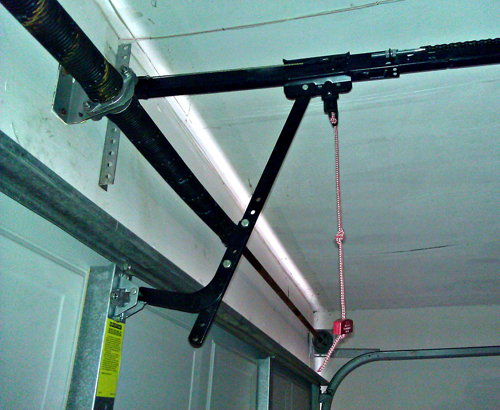
Huh.. he should be able to manually release the door from the inside (that's what the hanging handle [0] is for) and open/close it manually. Or hook up a wired keypad [1]
He can release the door from the inside, but when I said his garage only has one door I meant it only has the big door for the car that is controlled by the garage door opener. It does not have a separate human door.
He will probably install a keypad at some point, although since he is a drummer I suggested he do something that listens for knocking on the door in some complex rhythm that would be easy for him but hard for a non-drummer.
I think he hasn't done anything yet because he's got some longer term plans for some home sensor and automation projects, if I recall correctly, and it could make more sense to do the alternate garage door opening interface as part of that instead of as an isolated project.
I assume you mean that his car could be in the garage and he would be on the outside. If he were on the inside, he could use the emergency release that should be on every automated garage door.
Garages have internal buttons that trigger the door that are wired. If the child is so young that they can't use that, then they can't climb into the drivers seat and press the remote anyway.
This reminds me of an issue I encountered when working in comms at a university. The security guards reported that their radios were not working - the tower which was supposed to repeat their radios between different campuses wasn't working, due to huge interference.
After a few hours trying to figure it out (not being RF folks) the security guards realised that the USS Kitty Hawk was in Fremantle harbour - and that this had happened last time the ship visited.
Somewhat unfriendly of that aircraft carrier to stomp all over civilian radio, but it might have been some interaction between the type of transmission tower (a large mast on the roof of the tallest building on the campus) and something they were doing (their radar?)
This is likely a case of an infamous RFI problem. The spectrum is allocated to DoD, and garage door openers were allowed to use it provided they followed particular guidelines. Some follow them less faithfully and issues like this are the result. (There are other stories of equipment getting turned on that opens nearby garages with particularly bad implementations, but I don't know if they are true.)
I mean...there's not much more to the story than that. 2011 was a bit crazy for the Sun [1]. There were two or three x-class flares that jammed transmission for a short period. Multiple customer reports coincided with the February and August events that year. The February flare was caused by sunspot 1158 [2] and the August flare was caused by sunspot 1263 [3].
Deploying those locks across hundreds of locations we saw quite a bit of unusual stuff. Locks would work fine on one side of a building but not the other - the bad side faced the San Francisco bay - deduced it was from all the SF/Oakland Radio traffic.
Another location would experience problems during baseball games. (Stadium was next door).
Cell tower guys have even crazier stories. One involves my colleague who had a bitcoin mine in his garage. Few dozen graphics cards humming along at ~900MHz knocked out the whole voice uplink for 4 square miles. (He happened to be pretty close to the cell tower and raised the noise floor just enough to make cell phones all but useless.)
Working in ISM bands can be brutal, but it will teach you a lot and quickly.
The "sunspots" explanation doesn't pass the smell test for several reasons. It's the sort of thing you tell a customer to get them to go away and give the problem a chance to resolve itself.
More likely, in that part of the spectrum, they were seeing adverse effects from (probably undisclosed) military R&D activities. Might as well have been sunspots, for all they could've done about it.
Talk to the ham radio guys like me who operate (or operated) VHF/UHF weak signal.
At 433 that's pretty close to the 432.1 band some of us use.
Its possible for sunspots to really mess with HF and lower VHF like the 50 MHz 6M band but way off for 432.
Sunspot correlation with sporadic E (bouncing off the ionosphere) is common up to 50 MHz and drops off rather fast. I've made hundreds, thousands of contacts on 6M sporadic E but precisely one in my entire ham radio career on 2M which is 144 mhz pretty far from 432.
What does mess with vaguely 2M and up including 432 is tropospheric ducting. Basically a weather front or extreme fog makes a poor waveguide out of itself. Its somewhat location dependent.
One 70 cm band specific problem that could affect 433 mhz unlicensed stuff in a local area might be (legal ham radio) experiments with wide band ATV using a channel that overlaps the unlicensed band. That has nothing to do with sunspots.
Sunspots don't cause appreciable increase in RF background at any frequency at sea level. They cause lots more excitation of the ionosphere, so shortwave radio signals bounce better and further, but nothing up in UHF.
But other phenomena correlated with sunspots do cause UHF interference, so while wrong on the details I generally believe the story.
But other phenomena correlated with sunspots do cause UHF interference
What would be some examples of such phenomena, bearing in mind that we're talking about very short-range wireless links in a band shared with primary military users?
X-ray flares, which get through the ionosphere and mess with VHF and UHF.
The collapse of the magnetosphere on the night side following impact of a coronal mass ejection—which not only make a lot of VHF and UHF noise, they have enough power to just break a device.
If you use a lower freq band, you could discover the amazing world of the massive effect of sun spots, day/night cycle, mountains and buildings reflexions and the ionosphere effects.
PD: My father is a amateur radio operator that on his good times won some prices talking with people on the other side of the world with a relative low power signal.


In the early days of Lockitron we were using the 433MHz bandwidth. We would occasionally experience state wide non-response to our locks despite having full backend network connectivity. Eventually we tracked the problem down to sunspots. Coming from software it was one of the more bizarre things to debug.